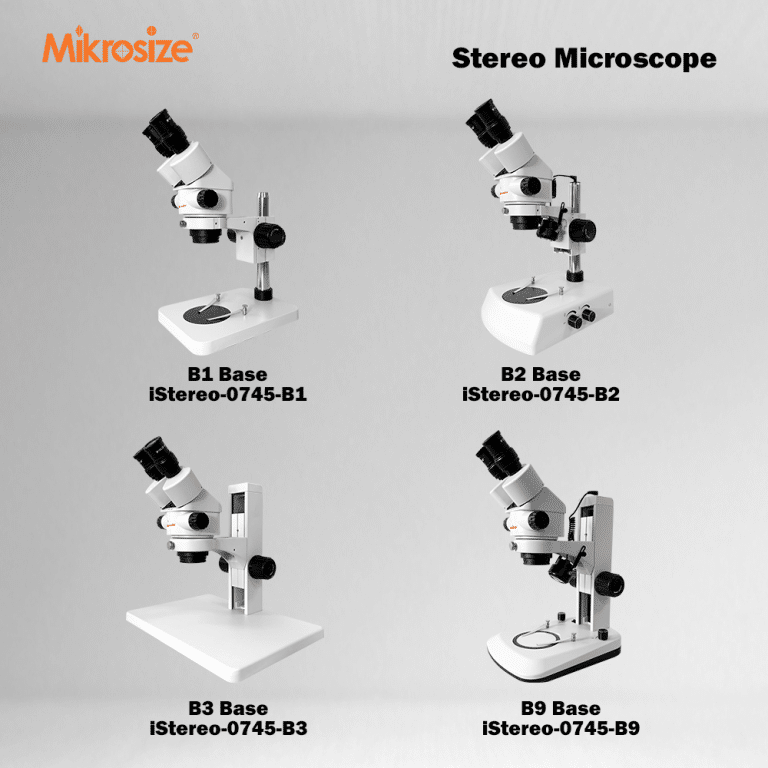
1. What Is a Stereo Microscope?
Also known as a dissecting microscope, the stereo microscope is a professional optical device that delivers true three-dimensional imaging. It adopts a dual-channel optical design, with a 12°–15° included angle between the two optical paths to simulate human binocular vision. The left and right eyepieces capture slightly offset images separately, which the human brain fuses into a single, depth-rich stereoscopic view. This imaging principle is fundamentally different from that of traditional single-path biological microscopes.
-1-177x300.jpg "Binocular or Trinocular Stereo Microscope: Which One Suits Your Needs? 2")
Stereo microscopes feature three irreplaceable core advantages:
- Orthoscopic 3D View: The image matches the actual orientation of the sample with no inversion, enabling intuitive and accurate judgment of spatial positions and defect morphology.
- Long Working Distance: A generous gap between the objective lens and the sample allows manual operations such as soldering, dissection and fine adjustment during observation.
- Continuous Zoom Optical System: It offers a standard magnification range of 6.7X–45X, extendable up to 270X with optional auxiliary objectives, covering both overall macroscopic views and microscopic details of samples.
- In short: Integrating 3D stereoscopic imaging, ample operational space and flexible magnification adjustment, the stereo microscope is an essential optical tool for electronic inspection, biological experiments, precision maintenance, jewelry identification and more industrial scenarios.
2. Binocular vs. Trinocular Stereo Microscope
Stereo microscopes are mainly divided into binocular and trinocular models to fit different application needs.
- Binocular Model: Designed purely for visual observation. With a simple structure and cost-effective performance, it is ideal for basic school teaching, routine manual sampling and personal skill training.
- Trinocular Model: Equipped with an independent CTV camera channel on the basis of binocular observation, without interfering with naked-eye viewing. It can be paired with industrial or digital cameras to realize real-time screen projection, image capture, dimensional measurement and data traceability, making it the mainstream choice for factory batch quality inspection, scientific research documentation and teaching demonstration.
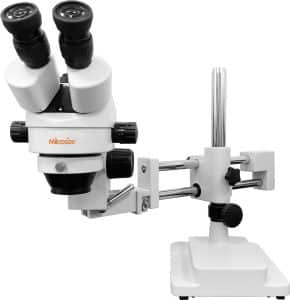
Functions of CTV Adapter
- The trinocular CTV port requires a matched CTV adapter to fit different camera sensor sizes, effectively solving common imaging problems such as cropped fields of view and dark edges. Common specifications include 0.3X, 0.5X and 1.0X.
- The Mikrosize iStereo series includes both binocular and trinocular configurations. The trinocular port is fully compatible with all matched CTV adapters, enabling convenient visual inspection, online data archiving and batch quality control.
-300x260.png "Binocular or Trinocular Stereo Microscope: Which One Suits Your Needs? 4")
3. Complete Step-by-Step Operation Guide for Beginners
Standard operation ensures high-definition stereoscopic imaging, avoids lens collision damage and extends microscope service life. Beginners can follow this standardized five-step process:1. Equipment (1).Placement & Installation
Fix the main unit on the matched base and place it on a stable, vibration-free table. For thick samples, raise the lens barrel in advance to prevent objective collision.
(2). Binocular Parameter Calibration
Slide the eyepiece tubes to adjust the interpupillary distance (54–76 mm adjustable range) until two separate views merge into a complete circular field. Independently calibrate the diopter of each eyepiece (±5 diopter adjustment) to adapt to individual eyesight differences and eliminate ghosting and blurriness.
(3). Reasonable Light Source Selection
Opaque samples (metals, chips, hardware): Use top reflected LED light;
Transparent or translucent samples (films, glass slides): Use base transmitted light;
Uneven or highly reflective workpieces: Install an auxiliary ring light to eliminate shadows and glare.
(4). Focusing & Continuous Zoom Observation
Start with the lowest magnification, locate the sample quickly via coarse focusing, then fine-tune for sharp imaging. Adjust the zoom step by step to magnify details. Equipped with a 0.67X–4.5X parfocal zoom objective (6.7:1 zoom ratio), the iStereo series maintains consistent sharpness across the entire magnification range without repeated focusing.
(5). Image Capture & Archiving (Trinocular Models)
Install a matched CTV adapter and connect an industrial camera to realize real-time screen projection, video recording and one-click image archiving for subsequent traceability, analysis and reporting.
4. Core Industrial Application Scenarios
(1). Electronics Manufacturing
Widely used for PCB solder defect detection, SMT component offset inspection, chip pin flatness observation, micro-crack detection on phone screens and semiconductor packaging appearance inspection, covering full-process quality control from incoming inspection to production and finished product verification.
(2). Biological Teaching & Research
Ideal for biological specimen dissection, micro-injection and sample separation experiments. Trinocular models support real-time screen projection for interactive teaching, making microscopic observation more intuitive and efficient.
(3). Precision Machining
Capable of detecting tiny defects such as burrs on aviation blades, mold wear and clock gear tooth deviation. The long working distance supports all-round inspection of large workpieces without dead angles.
(4). Jewelry & Antique Appraisal
With high-definition 3D imaging, it observes diamond cutting angles, internal gem inclusions and jade textures and flaws, providing reliable microscopic basis for jewelry identification and quality evaluation.
5. Conclusion
The Mikrosize iStereo series continuous zoom stereo microscope is equipped with a high-precision 0.67X–4.5X parfocal optical system and a 105 mm standard working distance, available in both binocular and trinocular versions. It supports a full set of matched accessories including CTV adapters, multi-spec auxiliary objectives and diverse light sources. Featuring a 45° inclined observation head and dual-side ergonomic focusing design, it balances outstanding imaging quality and long-hour operation comfort, fully adapting to electronics inspection, biological experiments, precision machining, jewelry identification and other diverse scenarios. For customized microscopic observation and quality inspection solutions, contact the professional technical team of Mikrosize to get exclusive optical system matching services.
-150x150.jpg)