-scaled-1-768x677.jpg "9 Most Confusing Questions About Digital Microscopes – Professional Answers from Mikrosize 1")
As precision manufacturing, SMT processing and material research keep upgrading, digital microscopes have become essential inspection instruments for quality control labs and production lines. Many purchasers and operators still have plenty of doubts about definition, application, pros and cons, operation and configuration of digital microscopy equipment. Today Mikrosize sorts out nine frequently raised questions and gives targeted, industry-focused answers.
Q1. What exactly is a digital microscopy system?
A digital microscope is an optical imaging system integrated with a digital camera, which removes the reliance on traditional eyepieces. Sample images are output directly to monitors for real-time observation and analytical processing. Some stereo or compound microscopes combine both eyepieces and digital cameras, which can record microscope status and camera parameter data.
Within this article, the term “digital microscope” refers specifically to eyepiece-free industrial inspection devices, rather than ordinary stereo microscopes retrofitted with external cameras.
Q2. What industries and tasks can digital microscopes be applied to?
High-performance industrial digital microscopes serve as all-round equipment for sample analysis, image capture and inspection report generation across R&D, on-site production and failure analysis workflows. They are widely adopted for incoming material inspection, in-process monitoring and finished product verification in mass production workshops, as well as dimensional testing and defect analysis in quality assurance departments, research institutes and university labs. Digital microscopes work well on metal, plastic, electronic and composite samples, supporting both planar microstructure observation and stereo defect detection.
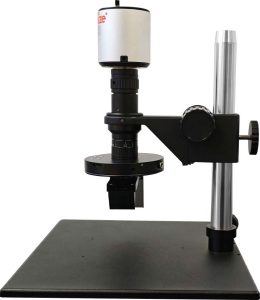
For instance, take the iVideo-0325 FA 3D Video Microscope launched by Mikrosize: it covers PCB, electronic component, precision machinery and new material inspection, and supports real-time comparison between live captured images and archived samples to identify abnormal parts during mass manufacturing.
Q3. What core strengths do digital microscopes have compared with traditional eyepiece microscopes?
The biggest advantage of digital microscopes lies in ergonomic design, greatly optimizing long-hour inspection work. Operators view images on a screen in an upright, relaxed posture instead of hunching over eyepieces, which effectively relieves visual and physical fatigue during high-volume sample testing. Most digital microscope software supports storing multiple groups of parameter presets. When multiple staff share one device, users can call their custom settings in one click without repeated adjustments, drastically boosting inspection efficiency. Besides basic observation functions, premium models integrate photography, video recording and dimensional measurement, realizing all-in-one operation without extra auxiliary tools.
Q4. Are there any limitations of digital microscopes?
Unlike stereo microscopes with eyepieces that support temporary observation without power supply, all digital microscopes require continuous power to operate the camera, light source and display module. Two mainstream connection modes are available: HDMI direct output to an independent display for quick on-site viewing, and USB3.0 high-speed connection to a PC for data archiving, measurement analysis and report export. Though wired connection is mandatory, it guarantees stable high-definition imaging performance.
Q5. What’s the difference between images viewed via digital microscopes and traditional eyepieces?
The basic sample information presented by both observation methods stays consistent, while two key differences exist. First, the field of view varies slightly depending on camera sensors and eyepiece magnification parameters. Second, conventional binocular stereo eyepieces deliver natural depth perception, whereas standard 2D digital microscopes only output flat images, making it hard to distinguish surface scratches from light reflection on glossy samples. 3D digital video microscopes solve this pain point perfectly. Equipped with a rotatable 3D observation mode, they restore true spatial contours of samples and eliminate misjudgment caused by planar reflection artifacts.
Q6. Do digital microscopes have simpler operation workflows than eyepiece microscopes?
Yes, especially for operators without microscopy experience. Traditional optical microscopes require lengthy practice to master focusing, light matching and eyepiece alignment. Digital microscopes adopt visualized mouse control systems, lowering the learning threshold significantly. Many devices feature encoded hardware linkage: zoom ratio, light brightness and grid parameters can be automatically recorded and retrieved. Batch testing and standardized report generation become much easier with one-click parameter recall. For example, Mikrosize’s iVideo-0325 FA 3D Video Microscope comes with visualized operation logic and a large stable base plate of 330×300mm. New staff can master the complete operation process in a short time without professional training. It supports one-click switching between 2D and 3D modes, and the built-in four-zone adjustable light source allows stepless brightness tuning to reduce reflection interference on different sample materials.
Q7. Do users need professional microscopy expertise to operate digital microscopes?
No advanced professional knowledge is required. Industrial digital microscopes are designed for plug-and-play use, friendly to both new inspectors and senior laboratory researchers. Encoded functional modules automatically record all configuration data, while rich built-in measurement tools complete quantitative analysis with simple clicks. Most high-end equipment achieves micron-level measurement precision to satisfy strict industrial detection standards.
Q8. What core components are required for a complete digital microscope system?
Matching modules and accessories are selected based on actual inspection demands. You can confirm your configuration needs with the following questions:
- Do you need ultra-clear imaging for tiny micro defects? Prioritize equipment equipped with a 4K ultra HD camera up to 3840×2160 resolution.
- Do you need smooth real-time image streaming for continuous production line testing? Choose models with high frame rate output.
- Do you need multi-angle stereo observation of sample side structures? Opt for devices with 360° rotatable 3D observation function.
- Do you carry out both appearance screening and precise dimensional measurement? Select systems with comprehensive built-in measurement tools.
- Do you inspect highly reflective metal or plastic samples? Devices with multi-area adjustable light sources can balance bright and dark image areas and suppress reflection. Mikrosize’s iVideo-0325 FA 3D Video Microscope is a fully integrated solution, fitted with a 0.6–5.0X continuous zoom lens, 4K auto-focus camera, four-zone ring light and full measurement software. It stores up to 8 custom preset schemes and supports grid customization, image comparison and four-split screen multi-sample analysis. The integrated measurement toolkit includes 18 types of measurement items with accuracy up to 0.01μm, fully meeting precision inspection standards.
Q9. Which core functions should buyers prioritize when purchasing industrial digital microscopes?
Combining long-term feedback from factory QC departments, research labs and university users, we list the must-have functions for industrial-grade digital microscopes:
- Optional 2D/3D observation modes with all-angle rotation for stereo defect identification;
- 4K high-resolution imaging to capture tiny micro defects such as solder balls ancomponent deformation;
- Rich built-in measurement functions with high precision and automatic data archiving;
- Multi-screen comparison function for consistency verification of mass-produced workpieces;
- Multi-zone adjustable light source to adapt to various metal, plastic and electronic samples;
- Stable mechanical structure and beginner-friendly visualized operation;
- Dual HDMI + USB3.0 output to adapt to both on-site display and offline computer analysis.
Conclusion
Digital microscopes have become indispensable equipment for modern precision manufacturing quality control, yet many entry-level devices are limited by flat imaging, single functions or complicated operations. Mikrosize develops professional 3D digital video microscopes to address these universal pain points. Products like the iVideo-0325 FA 3D Video Microscope integrate stereo observation, 4K ultra HD imaging, high-precision measurement and multi-sample comparison in one unit, matching the inspection demands of production lines, testing labs and academic research institutions across multiple industries.

-150x150.jpg)