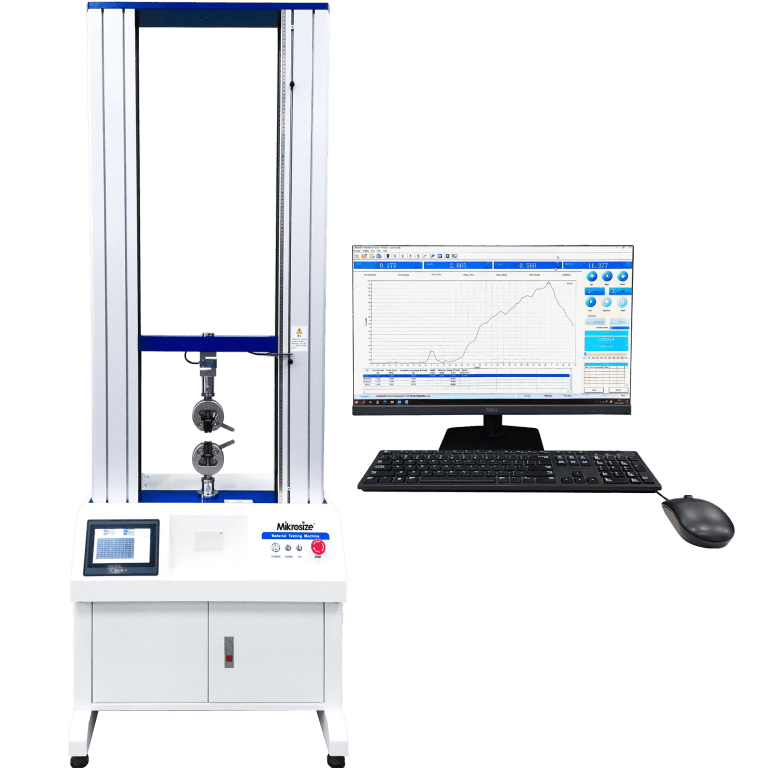
In the field of materials testing, the ability to accurately characterise mechanical properties under controlled conditions is fundamental to quality assurance and product development. The UTM-FDC Computerized Dual-column Servo Tensile Testing Machine from Mikrosize is a fully computer-controlled testing system engineered for precision, versatility, and long-term reliability. With a test force capacity ranging from 20 N to 50 kN across multiple models, this electronic universal testing machine is ideally suited for evaluating both metallic and non-metallic materials, including rubber, plastics, leather, textiles, composites, and sintered products.
Advanced Control and Drive Systems

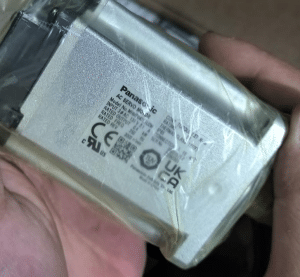
The UTM-FDC incorporates international brand components to ensure high reliability, stability, and precision. The power system utilises a Japanese AC servo motor with a high-precision ball screw, delivering smooth transmission, low noise, and a maintenance-free service life. The machine adopts full-digital pulse control, enabling a wide test speed range from 0.001 to 500 mm/min (up to 1000 mm/min optional). This versatility allows the instrument to perform tensile, compression, bending, peeling, tearing, and shear tests across a broad spectrum of materials.
The fully digital, closed-loop control system employs adaptive PID algorithms to achieve precise control of force, deformation, and displacement. The system automatically switches between control loops, ensuring smooth, impact-free transitions when changing modes—a critical feature for complex test sequences involving multiple loading regimes.
High-Precision Measurement and Data Acquisition
Sensing accuracy is paramount in materials testing. The UTM-FDC utilises load cells from a world-renowned manufacturer, offering excellent linearity, high accuracy, and extremely stable performance. The test force resolution reaches 1/500,000 of full scale, with an effective force range of 0.4% to 100% full scale and a precision of within ±1% of indicated value. Displacement resolution is ≤0.05 μm with comparable precision.
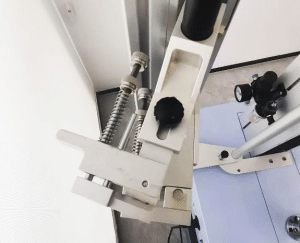
For materials exhibiting large deformation—such as rubber, elastomers, and certain plastics—the system can be equipped with a high-precision large-deformation extensometer (1000 mm range, 0.01 mm resolution). This accessory replaces traditional ruler-based measurement and manual calculation, significantly improving both accuracy and workflow efficiency. Optional metal extensometers and rubber extensometers are also available for smaller deformation measurements.
User-Centric Software and Touchscreen Interface
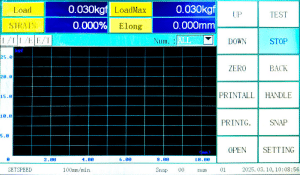
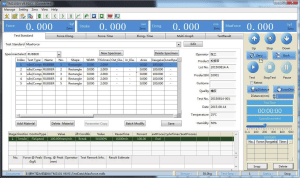
The UTM-FDC is controlled via intuitive touchscreen software that simplifies operation while offering comprehensive functionality. The main interface allows users to control machine movement, start or stop tests, zero test data, return the machine to its original position, and view or print results—all from a single screen.
Operators can select from multiple display parameters, including load, stroke, maximum load, elongation, real speed, test time, stress, and strain. The software supports three curve chart types: Force-Time, Force-Displacement, and Displacement-Time, with the ability to view and compare multiple test groups. Users can set test speed, select test direction (upward or downward), configure shutdown conditions, and establish breakpoint judgment parameters.
The system memory can store up to 12 test methods, and the software supports multi-curve display (force-deformation, force-time, deformation-time) on a single screen for comprehensive data visualisation. Test results can be edited, printed, exported to Excel, and historical data can be retrieved by date or sample number.
Comprehensive Protection and Safety Features
Operator safety and equipment protection are integral to the UTM-FDC design. The machine includes mechanical travel protection, an emergency stop button, and overload protection that automatically activates when the load exceeds the maximum by 10%. Limit devices prevent overshooting, and users can configure force value and deformation protection parameters. The system also features a deceleration coefficient to prevent displacement overshoot during return movements.
Applications Across Industries
The UTM-FDC is widely applied in mechanical performance testing and analysis across multiple sectors. It is suitable for medium-strength metals, sintered products, friction materials, rubber, plastics, thin films, fibres, adhesives, foam materials, elastomers, connectors, biomaterials, wood products, paper products, metal foils, wire, oil-bearing materials, ceramics, fasteners, and composites. In the rubber industry specifically, it is the primary instrument for optimising production formulations, conducting incoming material inspections, and controlling rubber material quality.
Models and Technical Specifications
-1-261x300.png "Computerized Dual-column Servo Tensile Testing Machine: Precision Material Testing with Mikrosize UTM-FDC 7")
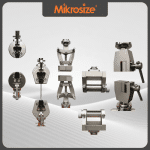
The UTM-FDC series includes models with test force capacities of 0.02 kN, 0.05 kN, 0.1 kN, 0.2 kN, 0.5 kN, 1 kN, 2 kN, 5 kN, 10 kN, 20 kN, 30 kN, and 50 kN, accommodating a wide range of testing requirements. The standard test width is 420 mm (650 mm optional), and the standard test height without clamps is 1330 mm. The mainframe is available with or without a working cupboard, with corresponding dimensions and weights detailed in the specification table. Standard delivery includes the mainframe, power cord, test software CD, data cable, fixture set, anti-flight excitation device (protective door), computer, printer, instruction manual, and certification documents. Optional accessories include a three-point bending fixture, four-point bending fixture, small-deformation metal extensometer, large-deformation extensometer, and other custom fixtures.
With its combination of precision, automation, and versatility, the UTM-FDC stands as a reliable solution for material testing laboratories seeking consistent, repeatable mechanical property data.
-150x150.jpg)