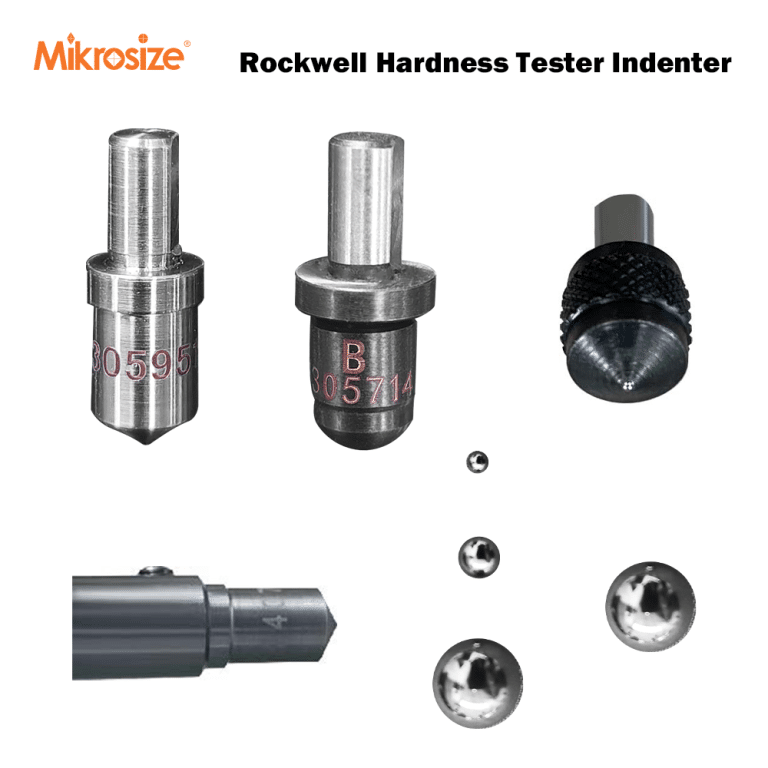
Rockwell hardness ball indenter
-19.jpg "How to choose rockwell hardness tester indenter? 2")
-15.jpg "How to choose rockwell hardness tester indenter? 3")
-19.jpg "How to choose rockwell hardness tester indenter? 4")
| Diameter | Application |
| 1.588mm | HRB,HRF,HRG,HRJ. |
| 3.175mm | HRE,HRH,HRK. |
| 6.35mm | HRL,HRM. |
| 12.7mm | HRR |
Rockwell hardness diamond indenter
-20.jpg "How to choose rockwell hardness tester indenter? 5")
| The cone angle | Spherical tip radius | Application |
| 120 degrees. | 0.2mm | HRA, HRC,HRD,HRN. |
Indenter Maintenance and Inspection
The precision and quality of the hardness tester indenter are critical factors in ensuring the accuracy of indicated values; its geometry, surface condition, and installation status directly affect hardness measurement results . Therefore, standardized daily maintenance and periodic inspection of the indenter are essential .
Daily maintenance involves monthly checks for indenter damage; if the indenter surface exhibits numerous dents or significant damage, it must be replaced to avoid measurement errors. During machine testing, care must be taken to prevent the sample from colliding with the indenter; fingers should be used to protect the indenter when removing the specimen stage or the specimen itself .
Inspection of the indenter primarily covers its geometry, surface roughness, material hardness, and installation status. For instance, issues such as deviations in the included angle between opposite faces, excessive transverse edge dimensions, high surface roughness, poor facet flatness or edge straightness, significant misalignment between the diamond’s crystallographic axis and the indenter axis, or insecure mounting can all affect the shape of the indentation and the measurement results .
Regarding inspection standards for Rockwell hardness testers, direct inspection requirements for diamond cone indenters specify that the spherical tip must be polished and free of surface defects within an indentation depth of 0.3 mm, and the conical surface must be perfectly tangent to the spherical tip. The indenter shape must be measured across at least four equally spaced cross-sections, and the diamond cone’s apex angle must be 120° ± 0.35°. The straightness deviation of the diamond cone’s generatrix near the junction must not exceed 0.002 mm within a 0.4 mm span, and the angle between the diamond cone’s axis and the indenter shank’s axis must be less than 0.5°. For ball indenters (steel or cemented carbide), requirements dictate that the ball surface be polished and free of defects, with diameter tolerance measurements taken at a minimum of three locations; the Vickers hardness must be at least 750 HV10 for steel balls and at least 1500 HV10 for cemented carbide balls. Improper installation of the indenter can also affect hardness measurement values. The correct installation procedure is as follows: insert the indenter into the spindle and lightly tighten the side screw; apply the preliminary test force and then loosen the screw; allow the indenter to penetrate the specimen surface under the total test force so that the indenter shoulder sits flush against the bottom face of the spindle; then, tighten the screw to secure the indenter. Note that while tightening the screw, you should apply counter-pressure to the opposite side of the spindle with your other hand to prevent lateral displacement of the spindle, which could damage the indenter.
-78x300.jpg "How to choose rockwell hardness tester indenter? 8")
-108x300.png "How to choose rockwell hardness tester indenter? 9")
-82x300.png "How to choose rockwell hardness tester indenter? 10")
-84x300.png "How to choose rockwell hardness tester indenter? 11")
Influence of the Indenter on Test Values
Factors such as the geometric deviations of the indenter, surface roughness, the accuracy of the diamond cone mounting, the integrity of the bond (brazing), and the crystal orientation all affect hardness measurement results. An increase in the diamond indenter’s cone angle or the radius of its spherical tip leads to higher hardness test values; deviations in the cone angle have a significant impact on low hardness values, while deviations in the spherical tip radius significantly affect high hardness values. A ball indenter diameter exceeding the nominal value results in higher hardness readings, with a pronounced effect on low-hardness materials; plastic deformation of the steel ball compromises measurement accuracy, so such indenters should not be used on high-hardness specimens and require periodic inspection. Indenter surface roughness failing to meet standards (Ra 0.2 μm requirement) increases indentation friction, thereby raising the hardness value—an effect particularly significant for low-hardness materials.
Improper indenter installation (e.g., axis misalignment) results in lower hardness values; the correct installation procedure involves tightening the indenter only after its shoulder is seated firmly against the spindle end face under the applied test force.
-150x150.jpg)