-768x677.jpg "3D Video Microscope: Break Through 2D Limitations for Advanced 3D Micro Inspection 1")
In industrial quality inspection, material research, gem identification, and biomedical studies, traditional 2D optical microscopes present notable limitations. Restricted by planar imaging technology, they only capture flat surface details without depth perception, surface undulation, or gap elevation data. This often leads to missed defects, subjective judgment errors, and inconsistent inspection results. As industries pursue higher precision, better visualization, and greater operational efficiency, 3D video microscopes have emerged as an upgraded mainstream solution. Integrating advanced optics, digital sensing, and intelligent 3D reconstruction algorithms, it overcomes the bottlenecks of conventional 2D observation and delivers more stereoscopic, accurate, and efficient microscopic detection.
1. What Is a 3D Video Microscope? Core Advantages
Different from conventional eyepiece microscopes that only produce flat 2D images, a 3D video microscope is an intelligent modern inspection device. It projects real-time microscopic footage onto a high-definition monitor and restores the true three-dimensional morphology of samples. It combines high-definition imaging, stereoscopic visualization, and intelligent data analysis to perfectly serve commercial inspection and scientific research scenarios.
It stands out from traditional devices with three core strengths:
- Genuine Full 3D Omnidirectional Observation: Supports ±45° tilting and 360° rotational scanning to capture side profiles, surface bumps, recessed gaps, and spatial textures that 2D microscopes cannot display. It completely solves the problem of single viewing angle and incomplete structural observation.
- Collaborative Visual Inspection: Abandons single-person eyepiece operation. Real-time video streaming enables multi-person synchronous viewing and team discussion. One-click screenshot, video recording, and data export support full data retention and team collaboration, which traditional microscopes cannot achieve.
- Micron-Level High-Precision Imaging: Equipped with professional optical systems and high-resolution imaging modules, it balances wide field of view and sharpness. It clearly displays ultra-fine microscopic features invisible to the naked eye and meets high-precision inspection standards.
2. 3D Video Microscope vs. Traditional Microscope: Full Upgrade
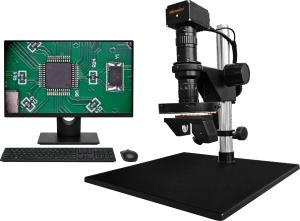
Many factories still rely on traditional optical microscopes, which feature cumbersome operation, low efficiency, and insufficient support for modern quantitative inspection and quality traceability. As an upgraded solution, the 3D video measuring microscope is embedded with intelligent measurement algorithms. It automatically calculates length, angle, area, radian, and other geometric parameters, realizing all-in-one observation, measurement, and data archiving.
-300x264.jpg "3D Video Microscope: Break Through 2D Limitations for Advanced 3D Micro Inspection 3")
- Ergonomic Operation: Horizontal screen viewing replaces long-time close eyepiece observation, effectively reducing eye strain and cervical fatigue for long-duration batch inspection.
- Higher Measurement Accuracy: Eliminates manual estimation errors caused by eyepiece micrometers. Intelligent automatic measurement achieves precision up to 0.01 mm for objective and quantifiable data.
- Remarkably Improved Efficiency: Supports automatic focusing, avoiding repeated manual focusing on uneven samples and achieving instant sharp imaging.
- Complete Data Traceability: One-click image and video storage supports batch archiving and data export, satisfying quality traceability, research documentation, and teaching review requirements.
- Powerful Team Collaboration: Breaks the limit of single-person observation. It supports synchronous viewing, remote guidance, and technical discussion for production line QC, laboratory R&D, and academic teaching.
3. 4K Ultra HD Upgrade: Redefine Microscopic Imaging Standards
High-end 3D video microscopes are equipped with industrial-grade 4K imaging sensors. With a resolution of 3840×2160, they deliver four times the pixel density of traditional 1080P devices, effectively resolving common issues such as missed micro-defects, blurry footage, and insufficient fine detail in conventional microscopic observation.
-21-300x137.jpg "3D Video Microscope: Break Through 2D Limitations for Advanced 3D Micro Inspection 4")
Key benefits of 4K ultra HD imaging:
- Accurately identifies micron-level tiny defects, including PCB wire burrs, micro cracks on solder joints, gear tooth profile deviations, and subtle surface scratches invisible on ordinary displays;
- Supports large-screen real-time sharing, ideal for remote consultation, team quality verification, and public teaching demonstrations;
- Adopts an integrated design and supports image capture, preview, and local storage without connecting to a computer, ensuring flexible and convenient operation.
4. Universal Industry Applications for Precision Inspection
Benefiting from stereoscopic imaging, ultra-high definition quality, intelligent measurement, and user-friendly operation, 3D video microscopes are widely applied in industrial manufacturing, gem appraisal, material science, biomedical research, and academic training as versatile precision inspection tools.
- Electronics & Semiconductor Manufacturing: Specialized in PCB solder joint defect detection, SMT mounting offset inspection, chip pin coplanarity analysis, semiconductor packaging verification, and micro flaw screening for precision electronic components, covering full-process production quality control.
- Gem & Jewelry Appraisal: Precisely measures diamond cutting angles and gem dimensions. Clearly presents internal textures, inclusions, and microstructures of jade and precious stones with a measurement error within 0.05 mm, providing objective data for value evaluation and authenticity identification.
- Material Science R&D: Observes metal grain structures, fiber morphology, and composite material interfacial conditions. Compares material wear, aging, and deformation degrees. It helps predict macroscopic material performance through microscopic analysis and supports new material development and quality optimization.
- Biomedical Research: Suitable for cell morphology analysis, dynamic tissue section observation, and minimally invasive surgical instrument calibration. Built-in 3D reconstruction enables microstructural modeling of cells and slices, providing accurate imaging support for fundamental research and auxiliary clinical diagnosis.
- Academic Teaching & Training: Upgrades traditional single-person observation to multi-person synchronous visual teaching. Featuring simple sample preparation and intuitive operation, it is widely used for biological slice observation, micro-phenomenon demonstration, and equipment fault analysis courses.
5. Microscope Selection Guide: Choose the Right Model for Your Needs
With various types of video microscopes available on the market, it is unnecessary to pursue over-specification. Select the model according to your actual inspection scenarios and precision requirements:
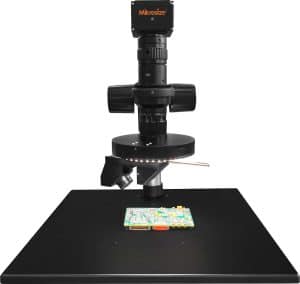
- For inspecting workpiece side structures and 3D flaws, choose a 3D stereoscopic microscope with switchable 2D/3D modes for comprehensive spatial detection;
- For large-size PCB and hardware workpiece inspection, select a wide-field microscope to complete full-area scanning without repeated sample repositioning;
- For routine quality inspection and basic dimensional measurement, a HD video measuring microscope delivers the best cost performance;
- For high-precision detection of reflective flat workpieces, a coaxial light microscope ensures uniform imaging and accurate flaw identification;
- For high-frequency batch production inspection and high-precision scientific research, the motorized auto-focus microscope with 0.1s ultra-fast focusing greatly improves working efficiency.
-1-300x291.jpg "3D Video Microscope: Break Through 2D Limitations for Advanced 3D Micro Inspection 5")
6. Conclusion: Intelligent Upgrading Trend of Micro Inspection
The upgrade from traditional 2D eyepiece microscopes to intelligent 3D video microscopes represents an inevitable trend in the precision inspection industry. It fundamentally solves the core pain points of traditional equipment, including single viewing angle, cumbersome operation, ambiguous data, poor traceability, and low collaboration efficiency. It upgrades microscopic observation from subjective visual judgment to objective 3D imaging and quantitative data analysis.
Today, 3D video microscopes are no longer exclusive laboratory tools. They have become essential equipment for industrial quality control, scientific research, academic training, and gem appraisal, balancing professional performance, practical usability, and high working efficiency. If you are seeking a reliable high-precision microscopic inspection solution for your application scenarios, you can select the most suitable model based on inspection accuracy requirements, sample dimensions, and testing frequency to significantly improve your overall inspection quality and productivity.
-150x150.jpg)