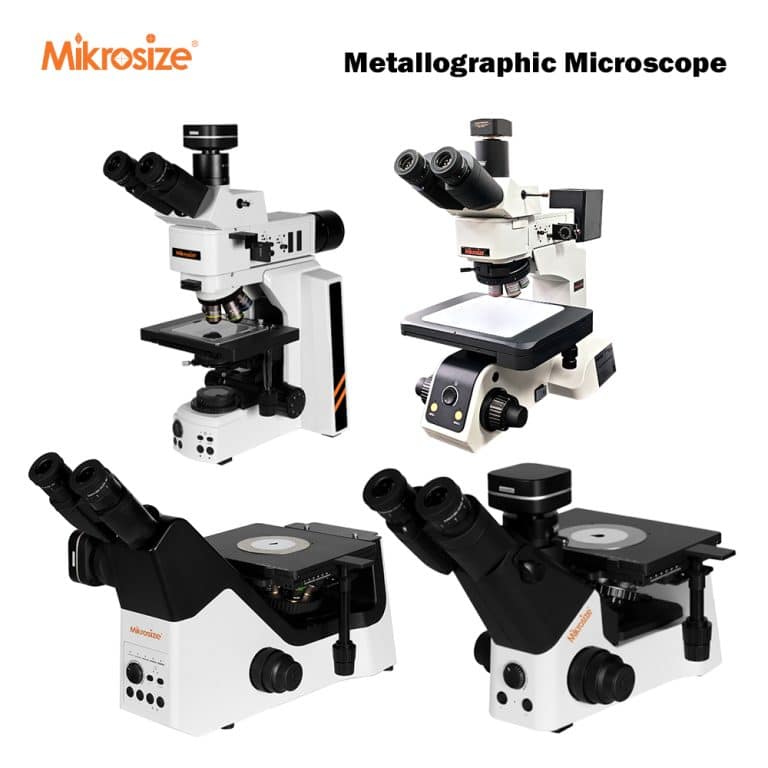
The choice between a purely reflective and a transflective metallographic microscope depends primarily on the sample type (transparent/translucent/opaque) and observation requirements (surface-only observation or simultaneous observation of internal structures).
Core Principles and Differences:
Reflective Type (Episcopic Illumination)
- Optical path: Light irradiates the sample surface through the objective lens from above and is reflected back to the objective lens for imaging.
- Application: Opaque samples (metals, alloys, ceramics, ores, PCBs, semiconductors, etc.)
- Observation: Surface morphology, crystal grains, inclusions, coatings, scratches, corroded microstructures.
Transflective Type (Combined Reflective + Transmissive System)
- Optical path: Equipped with both a reflective optical path (for surface observation) and a transmissive optical path (with a bottom light source to penetrate the sample).
- Application: Transparent/translucent/thin samples (glass, films, photoresists, biological sections, mineral thin sections, composite material thin layers).
Observation: Both surface features and internal/penetrative structures.
Core Comparison of Reflective and Transflective Types:
|
Dimension |
Reflective Type |
Transflective Type |
| Samples | Metals, dense ceramics, semiconductors, coatings (totally opaque) | Metals + transparent materials (glass, films, thin sections, minerals, PCB inner layers) |
| Functions | Bright field, dark field, polarimetry, DIC (reflective mode) | Reflective bright/dark field + transmissive bright/dark field + transflective polarimetry |
| Price | Lower (simple structure) | 15%–40% higher (dual illumination systems, condensers, color filters) |
| Optics | Optimized reflective optical path with high brightness and low stray light | Balanced for two optical paths; reflective light intensity is slightly lower in some models |
| Maintenance | Simple | Complex (two sets of optical paths, more lenses) |
| Typical Scenarios | Routine metal metallography, failure analysis, heat treatment, coating inspection | Material R&D, semiconductors, microelectronics, mineralogy, composite materials, multi-material laboratories |
Selection Criteria
Reflective Type
- Over 90% of samples are metallic/opaque materials (steel, aluminum, copper, alloys, weldments, powder metallurgy products).
- Only surface microstructures need to be observed (crystal grains, grain boundaries, inclusions, corrosion layers, scratches, coatings).
- Limited laboratory space and general maintenance capability.
Transflective Type
- Diverse sample types: metals + transparent/translucent materials (glass, films, photoresists, thin sections, minerals, plastics, composite materials).
- Penetrative observation is required (film thickness, internal defects, interlayer structures, distribution of transparent phases).
- Semiconductor/microelectronics field: chips, wafers, TFTs, LCDs, PCB inner layer wiring.
- Multi-material research: universities/research institutes, quality inspection centers, new material laboratories.
-150x150.jpg)