
In metallographic sample preparation, laboratories frequently struggle with tiny, hard-to-grip, and irregular-shaped specimens. Thin foils, metal wires, and granular particles cannot be manually held for standard grinding and polishing workflows.
These special-geometry samples often cannot be secured by conventional specimen holders. For instance, an irregular mineral ore piece with uneven surfaces will shift and vibrate during grinding and polishing if manually clamped. Uncontrolled movement leads to uneven surface finishing and ruins the quality of metallographic analysis.
The Powerful Solution: Metallographic specimen mounting technology
Metallographic mounting works as a universal workaround for tricky small-size samples, preparing specimens for subsequent grinding, polishing and microscopic inspection. Two primary techniques dominate practical labs: hot mounting and cold mounting, each with distinct strengths and ideal application scenarios.
Hot Mounting: High-Efficiency Processing for Conventional Specimens
Hot mounting suits specimens that resist minor heat and pressure deformation. It is widely adopted for routine metallic material metallographic analysis. Modern automatic hot mounting presses with water-cooling systems can finish a full mounting cycle in roughly six minutes.
Common hot-mounting media fall into two groups: thermosetting plastics such as bakelite powder, and thermoplastics like PVC. Bakelite delivers high hardness and excellent edge retention, perfectly suited for hard-metal specimens. However, it shows poor resistance to strong acid and alkali for chemical-analysis workflows. PVC offers good corrosion resistance and semi-transparent visual properties for internal observation, yet its softer texture requires careful polishing to avoid surface scratches.
Precise temperature and pressure control defines successful hot mounting. Excessive temperature may alter original grain microstructures and trigger grain growth. Over-applied pressure can introduce cracks and damage specimen integrity. Operators must tune parameters based on material characteristics.
An automatic hot mounting press completes embedding through four core stages:
- Heating phase: Internal heating elements rapidly raise mold temperature to 150-200 °C to soften polymer mounting compounds.
- Pressurizing phase: Hydraulic or mechanical structures apply pressure at 10-30 MPa, pushing softened resin to fully wrap around target specimens.
- Hold temperature-pressure phase: Maintain settings for 5-15 minutes to achieve complete resin polymerization and robust encapsulation.
- Cooling and demolding: Air-cooling or water-cooling reduces mold temperature down to ambient temperature, before releasing the finished solid mount.


Cold Mounting: Gentle Encapsulation for Heat-Sensitive Materials
Cold mounting is the preferred option for temperature-sensitive, pressure-sensitive, or micro-crack-containing specimens. For metallographic inspection of electronic chips, cold mounting prevents thermal damage to delicate internal circuit structures and preserves original component features.
Typical cold-mounting consumables include epoxy resin, acrylic resin, and polyester resin, each with unique merits:
- Epoxy resin: Low shrinkage rate and superior adhesion performance. It fills internal voids of powder-metallurgy samples, preventing powder shedding and cracking in follow-up grinding steps.
- Acrylic resin: Fast-curing performance, ideal for high-volume batches of irregular electronic components. It penetrates micro-cracks and protects sharp sample edges.
- Polyester resin: Long usable pot life, giving technicians ample operating time for non-porous specimen projects.

Practical Pro Tips for Reliable Mounting Results
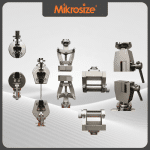
Several operational details directly impact final metallographic preparation quality. Thin strips and wire-form samples need dedicated stainless-steel or plastic fixtures to stop shifting during processing. When mixing cold-mount resin and hardener, strictly follow specified mixing ratios and stir thoroughly; incomplete curing will occur from incorrect proportions. Pour mixed resin slowly into molds and tap mould walls gently to release trapped air bubbles.
Keep your working environment dust-free to avoid surface contamination. Stable temperature and humidity conditions are critical for cold-mount workflows. Too-low ambient temperature slows resin curing; excessive humidity causes metal sample rusting and interferes with microstructure observation. Proper mounting greatly simplifies preparing tiny, irregular, or hard-to-hold specimens.
Conclusion
Choosing hot mounting or cold mounting depends on specimen geometry, material properties and laboratory throughput requirements. Improper mounting choices will trigger common defects such as edge rounding, micro-cracks, microstructure changes or incomplete encapsulation.
As a trusted global supplier of metallographic sample-preparation instruments and hardness-testing equipment, Mikrosize provides automatic hot mounting presses, matching mounting consumables and complete material-testing solutions. Mikrosize helps industrial quality-control labs, university research teams and third-party testing laboratories obtain stable, high-quality metallographic results for small and complex-geometry samples.