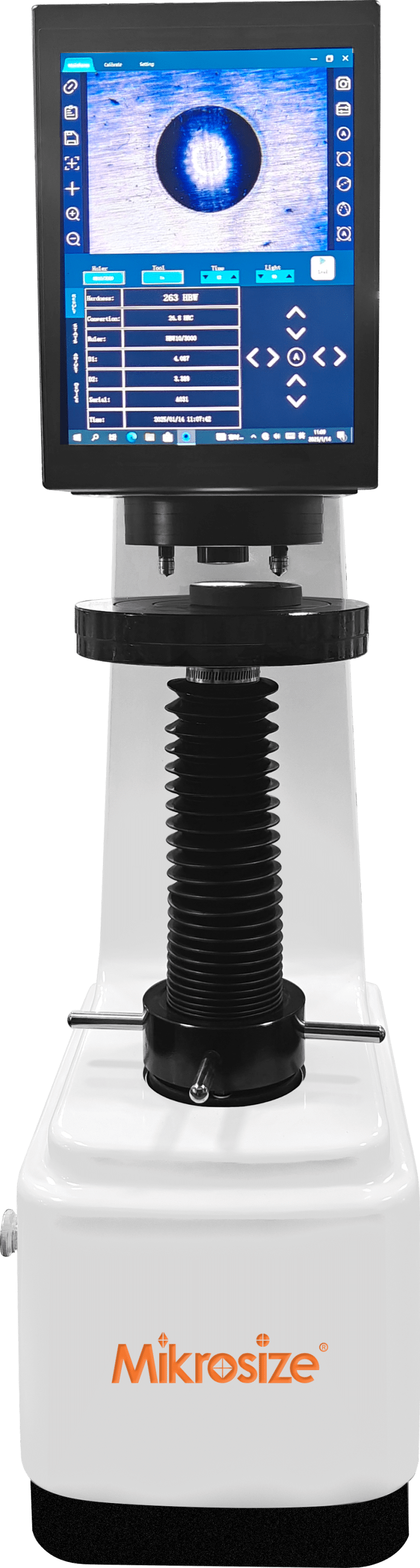
Mikrosize Brand offers customer different types of brinell hardness testers
https://mikrosize.com/products/hardness-tester/brinell-hardness-tester/
-124x300.jpg "How to Use Mikrosize Brinell Hardness Tester? 2")
-128x300.jpg "How to Use Mikrosize Brinell Hardness Tester? 3")
-214x300.jpg "How to Use Mikrosize Brinell Hardness Tester? 4")
1. Basic Operating Steps
Using a Brinell hardness tester is like giving a material a “physical exam”; key data can be obtained in just a few simple steps:
- Sample Preparation: Ensure the test surface is flat, clean, and free of oil or oxide layers.
- Parameter Setting: Select the appropriate load (typically 500–3000 kgf) and indenter diameter ( 10 mm steel ball is common) based on the material type.
- Positioning the Indenter: Place the sample on the worktable and turn the handwheel to bring the indenter slowly into contact with the surface.
- Applying the Load: Activate the loading mechanism and maintain the load for 15–30 seconds (materials like cast iron require longer durations).
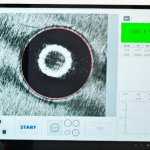
- Measuring and Reading: Use a microscope to measure the indentation diameter and consult a conversion table to determine the hardness value.
.jpg "How to Use Mikrosize Brinell Hardness Tester? 5")
.jpg "How to Use Mikrosize Brinell Hardness Tester? 6")
.jpg "How to Use Mikrosize Brinell Hardness Tester? 7")
.jpg "How to Use Mikrosize Brinell Hardness Tester? 8")
2. Critical Details for Successful Measurement
Don’t let minor errors ruin your test results:
- Environmental Vibration: The equipment must be installed on a stable platform, away from vibration sources like stamping presses.
- Temperature Fluctuations: Recalibration is required if the laboratory temperature varies by more than ±2°C.
- Indentation Spacing: The center-to-center distance between adjacent indentations should be greater than three times the indentation diameter.
- Sample Thickness: Must be at least eight times the indentation depth (generally over 1 mm).
- Data Recording: Record both the load magnitude and the dwell time (e.g., HBW10/3000/20).
.jpg "How to Use Mikrosize Brinell Hardness Tester? 9")
.jpg "How to Use Mikrosize Brinell Hardness Tester? 10")
.jpg "How to Use Mikrosize Brinell Hardness Tester? 11")
.jpg "How to Use Mikrosize Brinell Hardness Tester? 12")
3. Flexible Applications in Industrial Settings
The Brinell hardness tester is not just a laboratory tool; it is also used for:
- Incoming Material Inspection: Quickly determining if metal castings meet standards.
- Heat Treatment Monitoring: Verifying the effectiveness of quenching or annealing processes through hardness changes.
- Product R&D: Comparing the mechanical properties of different alloy formulations.
- Equipment Maintenance: Assessing the wear levels of gears and bearings after long-term use.
- Quality Traceability: Creating material hardness records to facilitate future analysis.
-150x150.jpg)