
In modern industrial manufacturing, accurate color control and color consistency are critical quality indicators for finished products. Whether evaluating appealing tones for food packaging, durable automotive coating finishes, uniform dyeing performance for textile fabrics, or realistic reproduction of printed materials, color appearance directly shapes end-user perception of product quality. Human visual assessment is subjective; visual judgements are heavily influenced by ambient lighting conditions, viewing angles, and individual eyesight differences. Manufacturers require objective, quantifiable tools to eliminate human error in color evaluation — and this is where industrial spectrophotometers become indispensable instruments for color management and quality control across production lines.
A spectrophotometer is an advanced optical measuring instrument that quantifies colour by analysing spectral reflectance or spectral transmittance of test samples. Based on spectrophotometry principles, it converts subjective human colour perception into objective numerical colour data, enabling precise colour transfer, colour matching and batch-to-batch colour consistency control. Today, portable spectrophotometers for color quality control are widely adopted in plastics, printing & packaging, textile, food processing, cosmetics, paint-ink and ceramic industries, acting as a universal technical language for cross-department and cross-supplier colour communication.
Fundamentals of Colour Science & Spectrophotometer Working Principle
How Human Eyes Detect Colour
To understand how a spectrophotometer measures colour, it helps to review human colour vision physiology. Human colour sensation originates when visible-range light stimulates three types of cone photoreceptor cells within the retina. These cone cells respond selectively to short-wavelength (blue), medium-wavelength (green), and long-wavelength (red) light respectively. Varying stimulation intensities are transmitted to the human brain to generate complete colour perception.
Visible light occupies a narrow band within the full electromagnetic spectrum, covering wavelengths from 360 nm to 780 nm, with different wavelengths corresponding to distinct perceived hues ranging from violet through to red. The International Commission on Illumination (CIE) standardises this visible spectral range, laying the foundational reference for all modern instrumental colour measurement work.
Theoretical Basis for Instrumental Colour Measurement
Modern colour measurement standards originate from specifications released by the CIE. Back in 1931, the CIE established the CIE XYZ tristimulus colour system and defined standard observer colour-matching functions, creating the theoretical foundation for objective colour quantification. In 1976, the CIE introduced the CIE Lab (CIELAB) perceptually-uniform colour space*, better aligned with human visual response for industrial colour-difference evaluation.
Within the CIE Lab colour space*:
- L* stands for lightness value, ranging from 0 (absolute black) to 100 (perfect white);
- a* represents the red-green axis: positive values denote red tones, negative values represent green tones;
- b* represents the yellow-blue axis: positive values denote yellow tones, negative values represent blue tones.
This intuitive numerical representation greatly simplifies color difference comparison and colour data exchange among factories, suppliers and laboratories worldwide.
Spectrophotometric Method versus Tristimulus Colorimeter Method
Two mainstream technical solutions exist for industrial colour testing: tristimulus colorimeter measurement and spectrophotometric measurement.
A tristimulus colorimeter uses optical filters to simulate human-eye tristimulus responses and directly outputs X, Y, Z tristimulus values for conversion into Lab* and other colour parameters. This type of instrument delivers fast readings, yet features relatively limited measurement accuracy and cannot capture full spectral curve information.
By contrast, a spectrophotometer captures spectral reflectance or transmittance data at each individual wavelength across the visible spectrum. Combined with CIE-defined standard light sources and standard observer functions, the instrument calculates complete sets of chromaticity parameters. Portable spectrophotometers for colour matching deliver superior measurement precision and store full spectral datasets, supporting complex colour-formulation analysis and computer-aided colour matching workflows. The complete spectral reflectance curve captured allows advanced diagnostics such as metamerism risk detection unavailable from basic tristimulus devices.


Technical Breakdown of Spectrophotometer Hardware
The core operating principle of a spectrophotometer relies on light-sample interaction: light emitted from the instrument light source strikes the sample surface and undergoes reflection, absorption or transmission. Most industrial colour-quality-control spectrophotometers focus primarily on measuring spectral reflectance properties of solid samples.
A high-performance spectrophotometer consists of these core optical assemblies:
- Light source system: Delivers stable, uniform illumination. Early instruments mostly adopted pulsed xenon lamps; contemporary models widely deploy full-spectrum LED light sources with extended service life and excellent long-term stability. Qualified light sources maintain complete spectral distribution across the visible band without missing critical wavelength segments.
- Spectroscopic system: Disperses composite white light into discrete monochromatic wavelengths. Diffraction gratings and interference filters represent common spectroscopic components. Planar grating spectroscopy delivers outstanding wavelength precision and spectral resolution and is widely implemented in premium-grade spectrophotometer hardware.
- Detector unit: Converts optical signals into readable electrical signals. Older units deployed photomultiplier tubes; modern instruments use silicon photodiode-array sensors or CMOS image sensors. Dual-array sensor configurations realise signal balancing and environmental-factor compensation, improving overall measurement repeatability and inter-instrument agreement.
- Integrating sphere (for d/8 optical geometry): A hollow sphere coated with high-reflectivity material that creates diffuse, uniform illumination conditions for sample surfaces. Premium-grade integrating-sphere coatings adopt weather-resistant high-reflectivity material superior to traditional barium sulphate formulations for stable long-term performance.
Spectrophotometer Categories and Key Characteristics
Classification by Form Factor
Portable / handheld spectrophotometer: Compact and lightweight for on-site field measurement; certain units support testing curved or irregular-shaped workpieces. These easy-to-operate field-ready instruments are deployed on production floors or during customer-site incoming-material inspections. Many modern handheld spectrophotometers integrate camera framing positioning plus intuitive colour touch-screen interfaces for straightforward operation even by beginner-level operators.
Benchtop / desktop spectrophotometer: Delivers superior measurement repeatability and long-term stability, designed for laboratory-grade precise measurement and colour-matching tasks. Benchtop spectrophotometers offer enhanced functional capability and higher accuracy for plastic colour formulation, textile dye development, paint-ink R&D and other high-precision colour-analysis scenarios.
Classification by Application Scenario
General-purpose spectrophotometer: Suited for routine colour testing across most common materials, widely used in plastics, coatings, textile and printing industries for general-purpose industrial colour quality inspection.
Specialised-configuration spectrophotometer: Custom-optimised for unique sample types, including dedicated setups for liquid samples, powder substances, and paste-form materials with custom sample holders.
Broad Industrial Applications for Spectrophotometers
Spectrophotometer technology applies across nearly every manufacturing sector requiring controlled colour output. Within traditional manufacturing segments including plastics & electronics, paint-ink coatings, textile-garment dyeing, and printing & packaging, spectrophotometers measure key metrics such as print colour density and dot gain, ensuring printed outputs conform to target colour specifications.
Within food-industry quality assurance, spectrophotometer for food colour measurement evaluates colour attributes for solid food items such as cheese, meat products, baked bread and pasta; powder-granular goods including flour, seasoning blends and roasted coffee; plus liquid samples such as tea infusions, fruit juices and sauces. Food colour serves as a critical visual indicator consumers use to judge freshness and overall product quality.
Acting as the technical bridge linking colour-science theory with real-world factory workflows, spectrophotometers have become essential manufacturing test equipment. Deep familiarity with spectrophotometer principles, technical traits and practical-application scenarios underpins robust enterprise-level colour-management programmes. As optical hardware and embedded software advance, spectrophotometer instruments grow increasingly accurate, user-friendly and intelligent, furnishing powerful support for colour-quality-control workflows across diverse industries.
Featured Instrument: Mikrosize iColor-T407 Spectrophotometer
The Mikrosize iColor-T407 portable spectrophotometer is built for both on-site rapid testing and laboratory-level precise colour analysis, perfectly addressing production-line colour-quality-control requirements across multiple vertical industries.
Core Product Features
- Adopts planar grating spectrometry paired with silicon photodiode-array sensors, delivering optical resolution below 10 nm to guarantee precise and stable colour measurement results.
- Supports multi-aperture switching: 8 mm, 4 mm and optional 1×3 mm measurement apertures. Users can select platform-style or tip-style measuring heads to accommodate samples of varying physical dimensions and surface sizes.
- Equipped with a 3.5-inch TFT true-colour capacitive touch screen; the intuitive graphical interface supports multi-language operation including Simplified Chinese and English.
- Built-in 5000 mAh lithium-ion battery supports up to 8500 measurement cycles within an 8-hour working window for excellent field-use battery performance; it features a universal Type-C charging interface for convenient power replenishment.
- Large-capacity local storage holds 500 standard colour references alongside 20 000 test-sample datasets. Dual-mode USB and Bluetooth data transmission simplifies traceable colour-data management.
- Implements dual SCI / SCE measurement modes, compatible with 2° / 10° standard observer angles, and provides 41 selectable CIE-compliant illuminant sources to match diverse real-world measuring environments.
- Ergonomically optimised hardware design; fitted with a wrist-band mounting post to prevent accidental drops, plus reinforced outer protective housing to mitigate damage from bumps and knocks during field-operation.
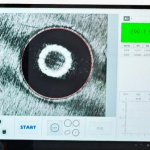
- Integrated camera framing positioning function together with stable film positioning ensures accurate aiming onto target test areas; straightforward workflow enables reliable operation for novice users.


Practical Application Capabilities
The Mikrosize iColor-T407 spectrophotometer fits colour-detection workflows for plastic-electronics, paint & ink, textile-garment printing-dyeing, commercial printing and ceramic manufacturing. It fulfils dual demands: fast on-site production-floor testing as well as precise laboratory analytical measurement. Common deployment scenarios cover incoming raw-material acceptance, in-process production-colour monitoring, and final finished-goods quality inspection.
Users can run side-by-side comparative measurements between standard reference samples and production test samples, quickly judging pass-or-fail colour conformance to streamline on-site quality-control decisions. The instrument connects with USB-compatible or Bluetooth-driven printers to print measurement reports in real-time for convenient on-site documentation and record-keeping. It supports measurement for both fluorescent-colour samples and ordinary non-fluorescent materials. Operators toggle the built-in UV light-source module to satisfy detection requirements for different material categories.
Conclusion
Consistent, repeatable colour performance represents an important competitive advantage for modern manufacturing enterprises. Subjective human visual inspection cannot reliably eliminate colour deviation risks across batch production, making reliable spectrophotometer colour-measurement equipment essential for factories pursuing stable product quality.
Understanding core colour-science theory, comparing spectrophotometer versus tristimulus-colorimeter technical differences, and selecting instruments matching actual sample conditions are vital steps to establish robust in-house colour-management workflows. The Mikrosize iColor-T407 spectrophotometer combines planar-grating high-precision optics, flexible multi-aperture configuration, powerful local-data-storage capability, long-lasting battery life, SCI/SCE dual-mode testing and fluorescence-sample compatibility. It serves as a versatile portable colour-testing solution bridging on-site shop-floor QC and laboratory-grade colour-analysis tasks for plastic, paint-ink, textile, printing, ceramic and many other industrial sectors. By deploying instruments such as the iColor-T407, businesses can convert ambiguous colour descriptions into traceable numerical colour data, minimise colour-reject losses and strengthen overall product-quality consistency.