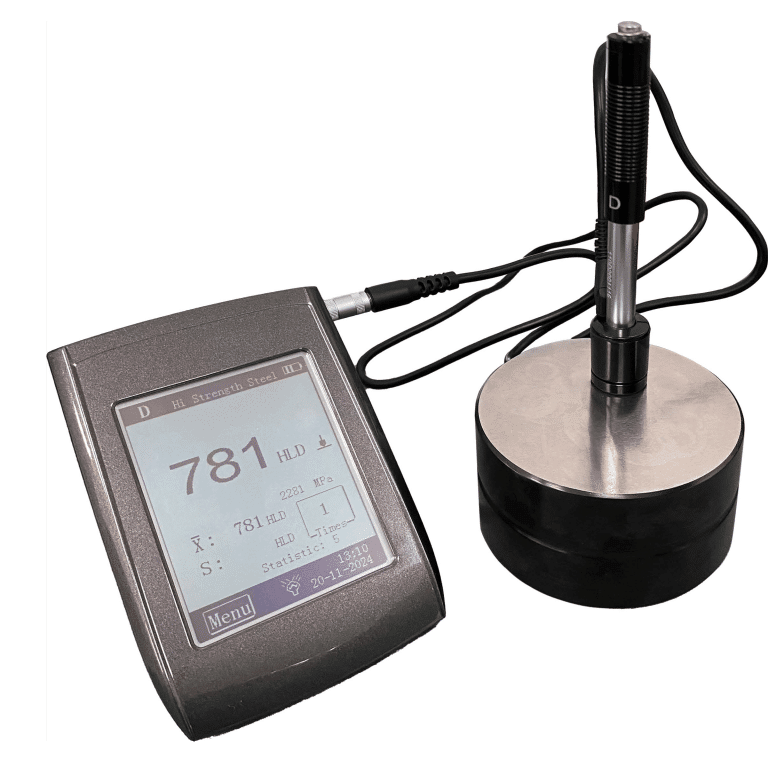
The Leeb hardness tester, a top-tier Chinese hardness testing instrument, is an essential testing instrument for modern industrial production, offering a portable, versatile, and highly reliable solution for measuring material hardness. As a professional hardness measuring device, it is engineered to resolve the drawbacks of traditional bench-top hardness testers. It features an intuitive menu-driven operating system for simplified operation, so operators with any level of experience can take precise measurements with little training. Its intuitive user interface simplifies access and management of all key test data.
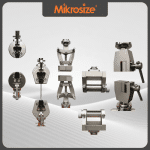
Its flexible connectivity is one of its core adaptable advantages. The tester is fitted with either a USB Type-C port or RS485 interface, offering two reliable options for data transmission and charging. This versatility is further amplified by its unique compatibility with a diverse range of impact probes. The tester supports up to seven types of interchangeable impact probes, each designed for specific applications and material types. A significant technological advantage is that no recalibration is needed when swapping different probes, as the tester automatically identifies the connected probe model. This seamless integration drastically reduces downtime and boosts testing efficiency in busy workshop sites and outdoor field testing scenarios.
-1-96x300.jpg "Leeb Hardness Tester | Portable Metal Hardness Gauge for Large Workpieces 2")
-300x300.jpg "Leeb Hardness Tester | Portable Metal Hardness Gauge for Large Workpieces 3")
-208x300.jpg "Leeb Hardness Tester | Portable Metal Hardness Gauge for Large Workpieces 4")
iLeeb-150 Pen Type Leeb Hardness Tester iLeeb-210 Leeb Hardness Tester iLeeb-300 Color Screen Leeb Hardness Tester
If purchased from a reputable hardness tester supplier such as Mikrosize, this instrument guarantees stable performance and reliable data integrity for users. This Chinese hardness tester supports multiple hardness scales (such as HL, HRC, HB, HV, etc.) and can even convert test readings into three types of tensile strength values, making it an indispensable tool for engineers and quality control professionals. For data management, it boasts ample internal storage with capacity ranging from 373 to 2,688 data sets. Each data set stores single measured values, average results, test date, impact direction, impact count, material grade and hardness scale parameters, facilitating complete traceability for quality control.
To streamline high-volume production checks, this hardness measuring device supports preset upper and lower hardness tolerance limits. The unit will automatically sound an alarm if any measurement falls outside the preset tolerance range, providing immediate feedback for batch testing and ensuring only components within specification proceed. Furthermore, it comes with a software-based indication calibration function to sustain long-term measuring accuracy, and its performance complies with the strict Chinese national standard GB/T 17394.2. These advanced functions are powered by a built-in high-capacity lithium battery paired with an intelligent charging management circuit, designed for long continuous working hours and extended standby time to support long shifts and outdoor field operation.
Its full functional potential can be unlocked via connection to a dedicated data management system. Optional dedicated PC software supports advanced data search, secure long-term data archiving, statistical analysis and bar charts for trend tracking. For immediate reporting, it integrates an embedded thermal printer module to print test data in real time for instant on-site record keeping. Purchases from Mikrosize include not only the tester hardware, but also a full set of supporting solutions and professional technical after-sales service.
-1-300x235.jpg "Leeb Hardness Tester | Portable Metal Hardness Gauge for Large Workpieces 5")
-1-300x223.jpg "Leeb Hardness Tester | Portable Metal Hardness Gauge for Large Workpieces 6")
-1-300x228.jpg "Leeb Hardness Tester | Portable Metal Hardness Gauge for Large Workpieces 7")
-1-300x213.jpg "Leeb Hardness Tester | Portable Metal Hardness Gauge for Large Workpieces 8")
The Leeb hardness tester boasts an extremely wide range of applications. It is mainly used to test the Leeb hardness of ferrous and non-ferrous metals. Its portability makes it the ideal choice for measuring large, heavy workpieces or fixed on-site components that cannot be transported to laboratory testing rooms. It is also the optimal solution for hardness testing in narrow, confined spaces inaccessible to bench-top hardness testers, demonstrating its outstanding practicability across industries including metal manufacturing, welding inspection, aerospace engineering and power generation equipment maintenance.
-150x150.jpg)