Introduction
Universal tensile testing machines, also widely named electronic universal testing machines (UTM), are indispensable laboratory instruments across flexible-packaging production, thin-film manufacturing, metal material labs, rubber-plastic processing and paper-product quality control. Operators rely on these material testers to run critical tests including tensile strength test, peel strength measurement, puncture resistance test, tear strength evaluation, and elongation-at-break analysis.
By carrying out standardized mechanical property testing during incoming-material inspection and finished-product QC, manufacturers can spot potential production defects in advance, mitigate product failure risks, and minimise unnecessary economic losses.
When you start shopping for a computer-controlled universal testing machine, many buyers get confused by mixed technical parameters, varied drive configurations and conflicting vendor claims. This buying guide walks you through all core selection criteria. We will also introduce Mikrosize UTM-E100/E200/E300 Computer Controlled Electronic Universal Testing Machine, a high-performance option for diverse material-testing workflows.
1. Force Capacity, Test Stroke and Basic System Configuration
The maximum test-force range directly determines which load cell will be fitted, impacts overall machine structure, and heavily influences total equipment cost. For most flexible-packaging factories, a force capacity around 300 N meets routine film-testing requirements.
For thin-film and flexible-substrate samples, the effective test stroke of 600-800 mm is generally sufficient for standard elongation-related experiments.
Three core building blocks make up an intelligent universal tester: main machine host, control computer and output printer. Advanced micro-controller versions support direct print-out without extra PCs. If equipped with a desktop or laptop computer, matched control software enables sophisticated data-processing tasks: raw-data editing, curve partial zoom-in, custom report formatting and batch-sample statistical analysis.
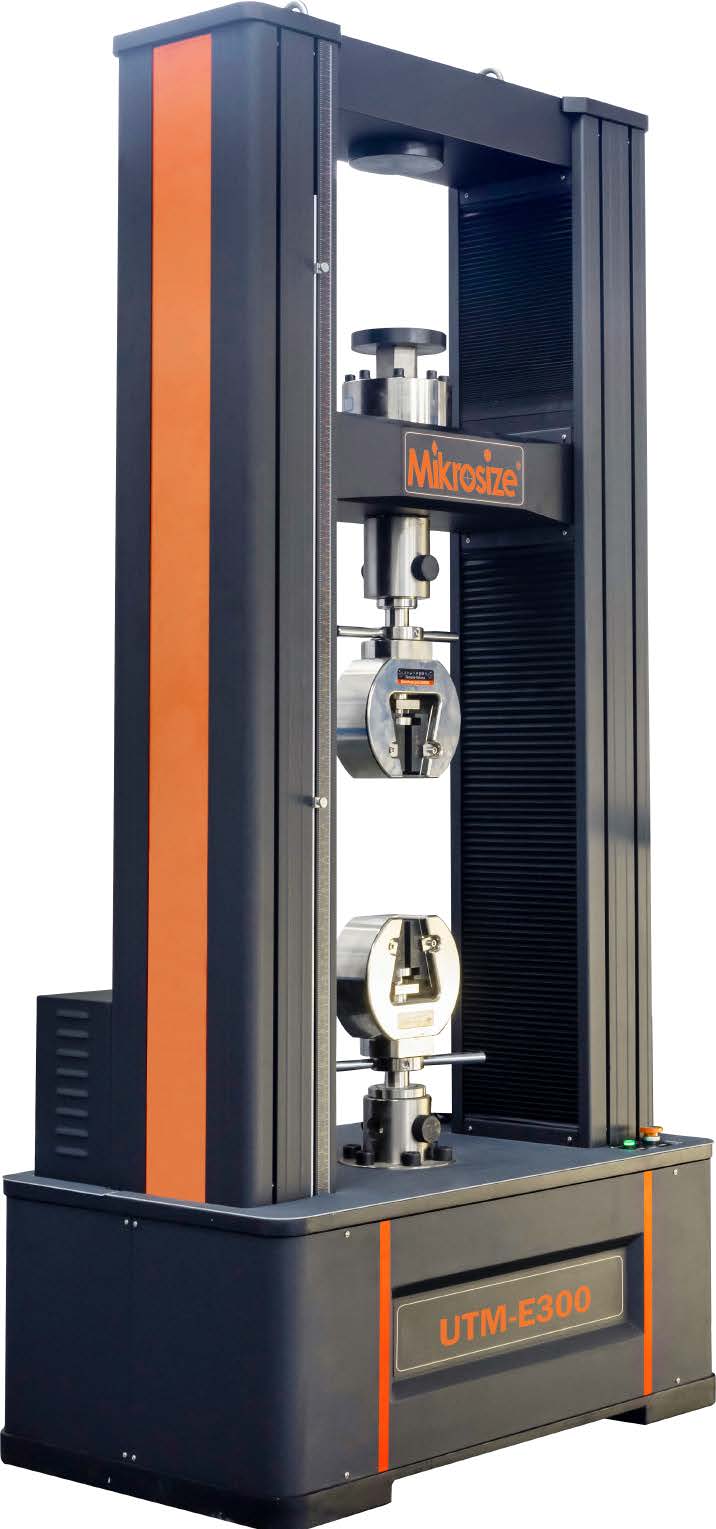
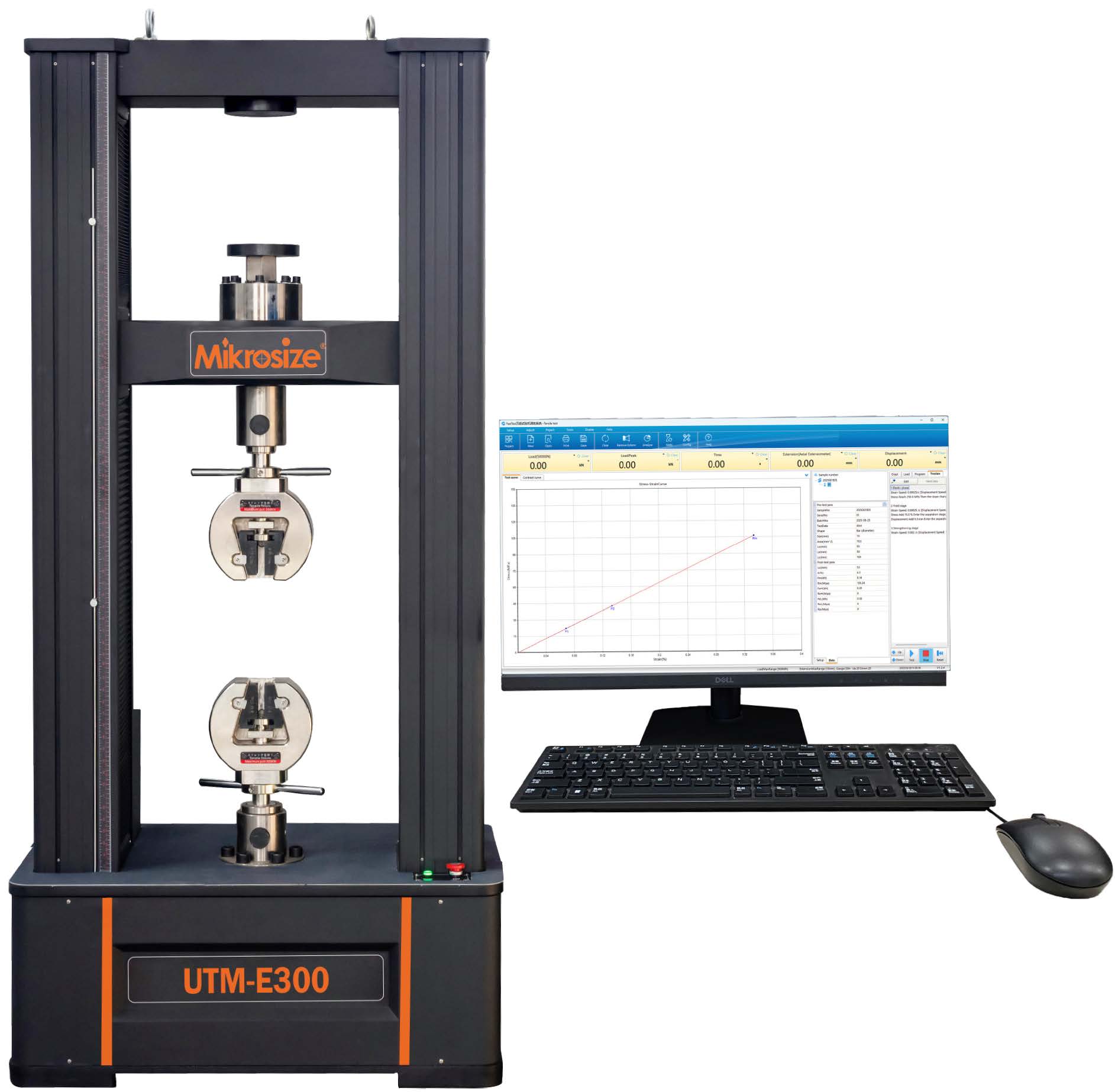
Real-world product reference: The Mikrosize UTM-E100/E200/E300 Computer Controlled Electronic Universal Testing Machine adopts a rigid floor-standing gantry frame structure, assembled by upper crossbeam, movable crossbeam, workbench, support columns and ball screws to deliver stable, reliable running status. Its movable crossbeam comes from one-piece casting, resisting deformation under full load. This series supports a maximum test force up to 100 kN, covering low-force flexible-film testing as well as high-load metal-specimen evaluation. It can run tensile tests in the upper test zone and compression tests in the lower zone simultaneously. Users can connect external computers or use the independent dedicated controller for flexible workflow setup.

2. Confirm Which Test Modes Your UTM Needs to Support
Modern production labs expect a multi-functional universal testing machine that delivers multi-mode testing simply by swapping dedicated fixtures. Without changing core hardware, qualified equipment should execute tension, compression, bending, tear, shear, 180-degree peel and 90-degree peel tests for different specimen types.
Custom-fixture compatibility is an important point to check before purchase. Many low-cost devices only support limited test types and cannot adapt custom grips for special-shaped samples.
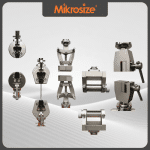
Product highlight for reference: Mikrosize UTM-E100/E200/E300 comes with standard tension-compression fixtures out-of-the-box, while custom-made fixtures are available on request to satisfy peel, tear, bend and other non-standard test scenarios. It fits multi-industry test requirements for metal materials, plastic-rubber goods, textiles, leather, paper & packaging materials and construction building materials.
3. Evaluate Test-Speed Range & Drive System Performance
You will find two mainstream speed specifications on the market for electromechanical tensile testers:
- 10-500 mm/min with ordinary adjustable-speed drive: lower price yet coarse speed control, brings noticeable deviation for precision-demanding jobs.
- 0.01-500 mm/min driven by servo motor system: higher investment yet far superior speed accuracy and test repeatability.
For flexible-packaging enterprises, a servo-driven UTM with speed coverage 1-500 mm/min strikes the ideal balance between reliable precision and reasonable total cost. Keep in mind most entry-level machines priced around 10,000 USD are fitted with ordinary variable-speed motors, whereas a standalone high-quality servo motor already accounts for a considerable portion of hardware expenses.
Mikrosize technical match-up: Mikrosize UTM-E100/E200/E300 series is servo-motor driven, with wide test-speed range of 0.001 – 500 mm/min. This ultra-wide adjustable speed range handles slow-rate material deformation tests as well as fast fracture simulation tests. A magnetic handheld control box is supplied, allowing convenient remote operation instead of standing beside the main unit all the time.
4. Inspect Measurement Accuracy Indicators
Complete accuracy assessment covers force-measuring precision, speed accuracy, deformation accuracy and displacement accuracy. Top-tier lab-grade equipment can reach ±0.5 % full-scale accuracy. For most industrial quality-control workshops, ±1 % accuracy class already satisfies routine production-inspection demands. Nearly all mainstream modern testers provide force-value resolution up to 1/100 000, so resolution is rarely the bottleneck.
Mikrosize reference detail: Equipped with high-precision sensor plus dedicated independent controller and measurement-control software, Mikrosize UTM-E100/E200/E300 guarantees stable measuring precision. Multiple selectable measuring-unit options are built in:
- Force units: KN, N, kgf, lbf
- Displacement units: mm, cm, dm, m, in, ft, mil After finishing each test run, the crosshead can automatically return to starting position, saving manual reset time and lowering human-operation error.
5. Compare Transmission Mechanism: Ball-Screw vs Rack-Pinion Drive
Two common transmission structures exist for universal testing equipment:
- Ball-screw transmission: higher cost, outstanding positioning precision and excellent test repeatability. Highly recommended for heavy-use flexible-packaging labs that run tests every day. Among screw types, ball screws achieve the highest accuracy, best paired with servo control systems to unlock full performance.
- Rack-and-pinion transmission: low acquisition cost, yet poor repeatability and low precision output, not fit for frequent high-accuracy QC work.
The quality of the screw directly decides force-reading stability. Never overlook this mechanical component when comparing machine proposals.
Mikrosize frame advantage: As mentioned earlier, Mikrosize UTM-E100/E200/E300 utilises ball-screw transmission cooperating with rigid gantry frame, securing stable transmission performance and consistent repeat test data even under long-hour continuous operation. Multiple safety protection mechanisms including mechanical travel limit switches, emergency-stop button and overload-protection function prevent specimen-induced equipment damage.
6. Load Cell (Force Sensor) Service Life
Load cell longevity represents a major hidden cost factor of tensile testers. Premium sensors from top international brands and qualified domestic joint-venture manufacturers can support over 100 000 test cycles before performance degradation. Cheaper sensors drift quickly after frequent testing and demand frequent re-calibration, increasing long-term maintenance expenditure.
For Mikrosize UTM-E100/E200/E300: high-grade high-precision sensors are adopted, engineered for long-term cyclic testing scenarios in QC laboratories and R&D centres.
7. Machine-Processing Craftsmanship Determines Long-Term Stability
Different manufacturing processes — turning, grinding, planing, milling, CNC machining and wire-cutting — bring big gaps in mechanical rigidity, structural stability and service lifespan. High-precision processing prevents frame deformation under load and avoids gradual accuracy drifting after years of usage. Low-grade rough machining will cause frame distortion and unreliable test readings.
The one-piece cast movable crossbeam of Mikrosize UTM-E100/E200/E300 is manufactured via precise machining workflows, helping the whole gantry maintain structural rigidity even under maximum rated load.
8. Software Capability & Industry-Standard Compliance
Many buyers only focus on main-unit hardware yet ignore software functions. Powerful test software greatly improves lab efficiency.
Key software features you should check:
- Real-time multi-mode curve plotting: force-time, stress-time, strain-time, displacement-time curves
- Auto calculation of critical parameters: maximum force, average force, maximum deformation, tensile strength, yield strength
- Editable test-report templates, multi-format export (Word, PDF, Excel)
- Compatibility with mainstream Windows operating-system versions
- Support for global testing standards and user-defined calculation formulas
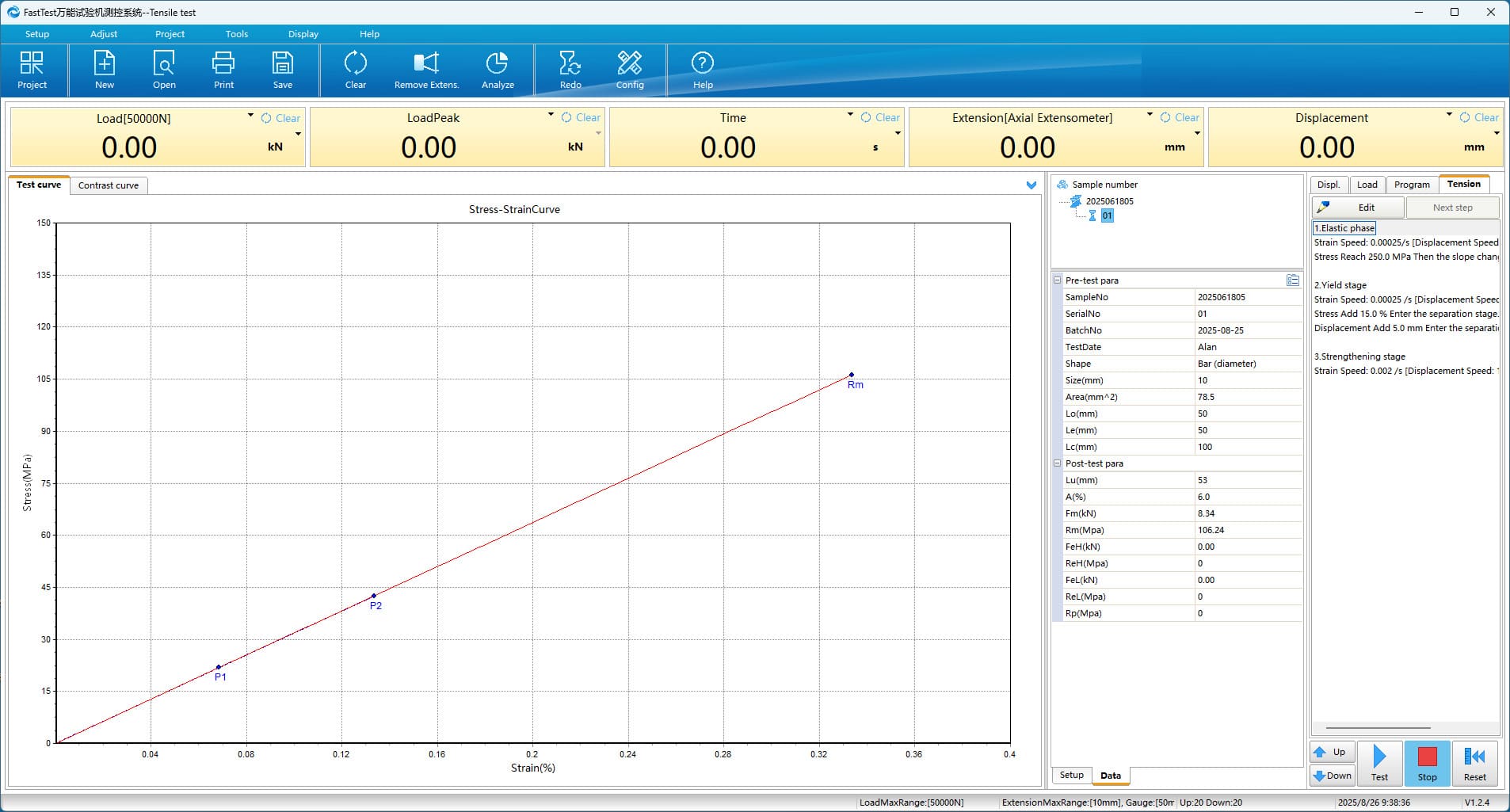
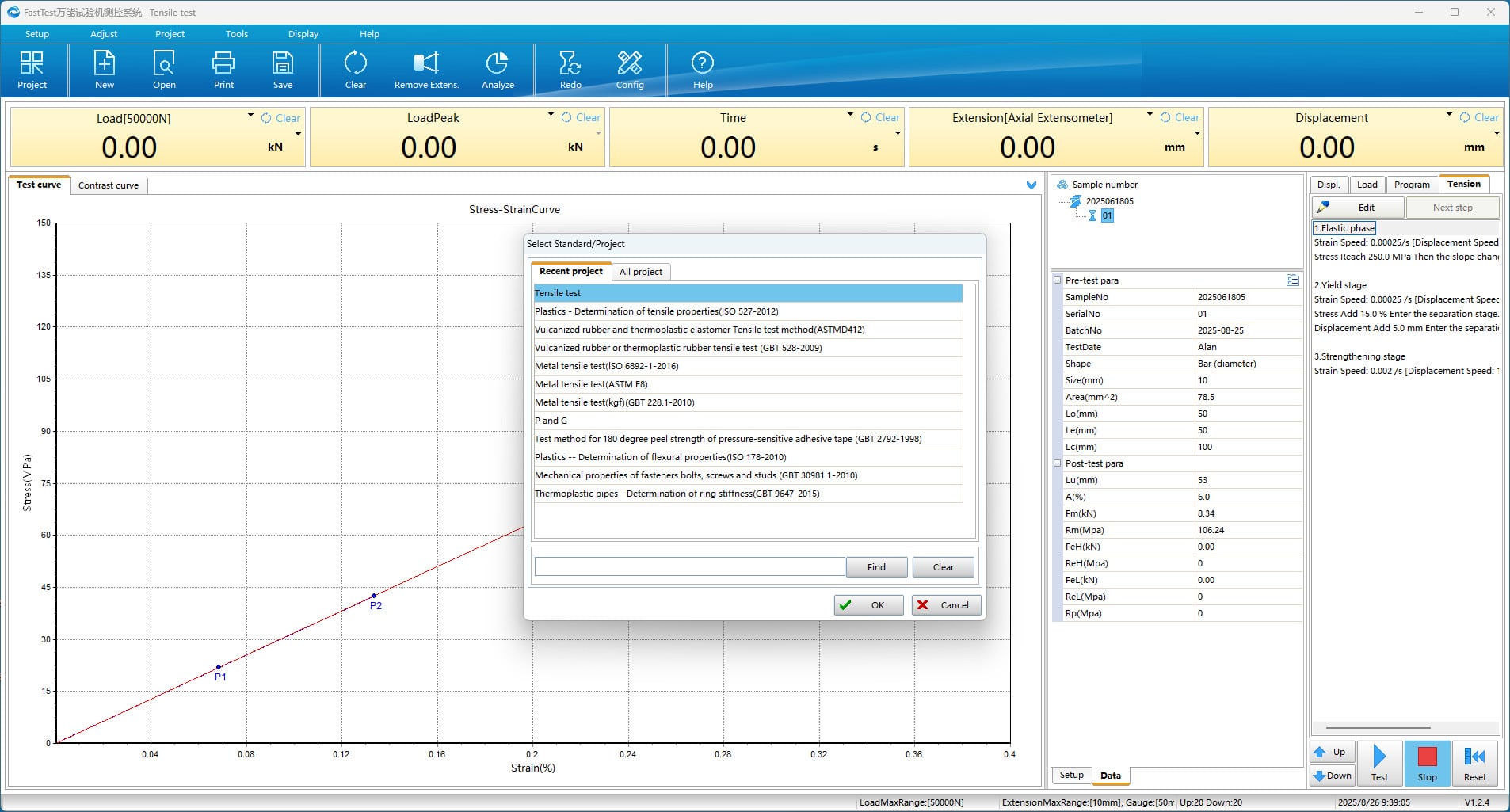
Mikrosize UTM-E100/E200/E300 software advantages: Its dedicated measurement-control software uses modular open-architecture design. Pre-installed mainstream standards include GB, ASTM, DIN, ISO, JIS. Besides built-in standard calculation logic, operators can customise calculation formulas for special in-house test methods. Real-time multi-group curve generation is supported, and key mechanical parameters get calculated automatically. Customisable report templates support export to Word, PDF and Excel formats. The software runs smoothly under Windows 7, Windows 10 and Windows 11.
In terms of standard compliance, the machine complies with GB/T 2611, GB/T 16491, GB/T 16825, GB/T 228, ISO 527, ASTM D3574, DIN 53357, JIS K6854 and other global test standards.
Real-World Application Scenarios of Mikrosize UTM-E100/E200/E300
This computer-controlled electronic universal testing machine covers multi-sector material-testing tasks:
- Metal-material sector: raw-material quality inspection, processing-technique validation, finished-component performance testing
- Non-metallic-material sector: plastic-rubber product tests, textile & leather testing, paper and flexible-packaging-material evaluation
- Building-material industry: physical-property detection for construction materials
- Research & education: laboratory scientific experiments and classroom teaching demonstrations
Final Checklist Before You Place Your Order
Before finalising procurement of your universal tensile tester, tick through this checklist:
- Force capacity and stroke match your specimen types
- Servo-driven system selected if high precision is required
- Supported test modes plus fixture customisation availability
- Measurement accuracy class and load-cell expected service cycles
- Transmission type (prioritise ball-screw for high-repeatability work)
- Software functionality, report export and standard-compliance status
- Safety protection devices (emergency-stop, overload protection, travel limit)
Frequently Asked Questions (FAQ)
Q1: What force capacity do I need for flexible-film packaging testing?
A: For most flexible-packaging thin-film samples, 300 N-2 kN force range is adequate. If you test thicker rigid-plastic or metal samples, consider higher-capacity models such as Mikrosize UTM-E100/E200/E300.
Q2: Why is servo drive better than ordinary variable-speed drive?
A: Servo-motor systems deliver stable speed output across full speed range, minimise test deviation and guarantee repeatable test results, which is essential for reliable QC data.
Q3: Can Mikrosize UTM-E100/E200/E300 run both tensile and compression tests?
A: Yes. The upper section serves as tensile-test working space and the lower section works for compression testing, allowing users to switch test modes by changing fixtures.
Conclusion
Purchasing a suitable computer-controlled electronic universal testing machine is not merely about comparing quoted prices. You must balance force capacity, drive performance, transmission quality, sensor reliability, software functions and real-application scenarios.
The Mikrosize UTM-E100/E200/E300 Computer Controlled Electronic Universal Testing Machine integrates rigid gantry mechanical structure, servo drive, high-precision sensors and powerful open-format test software. It serves flexible-packaging factories, plastic-rubber manufacturers, metal-processing plants, building-material labs and educational institutions for consistent, traceable material-mechanical-property testing.
If you want to get more detailed specification sheets or quotation information, please feel free to contact our Mikrosize sales team.
-150x150.jpg)