In electronics repair work, a digital multimeter acts as the core diagnostic instrument for technicians, hobbyists and maintenance engineers. Whether troubleshooting printed-circuit-board faults, verifying component integrity, checking power-supply output, or tracking down open-circuit and short-circuit failures, a reliable handheld multimeter delivers measurable electrical data to avoid blind component-replacement guesswork. Without dependable multimeter testing equipment, repair personnel risk misdiagnosis, wasted spare-part costs, and even secondary damage to sensitive electronics assemblies. Not all portable multimeters perform equally under real-world repair-shop conditions. Beyond basic voltage-current-resistance reading functions, practical repair scenarios demand anti-interference performance, user-friendly display design, safety safeguards, and practical auxiliary functions to streamline daily fault-locating workflows.
When technicians evaluate a multimeter for electronics repair applications, several practical characteristics directly shape on-site working efficiency. First, full-function overload protection safeguards both the instrument and sensitive PCBs from operator mis-operation, such as mis-selecting measurement modes or connecting probes to wrong terminals, which is extremely common in fast-paced repair environments. Second, strong anti-magnetic and anti-interference capability stabilizes readings near switching power supplies, motors and densely-packed circuit boards where electromagnetic noise disturbs weak-signal measurements. Third, practical convenience features including data hold function, backlit LCD screen, and auto-power-off help technicians capture readings in dim workbenches, freeze unstable values for note-taking, and conserve battery life for long-shift repair work. A comfortable, ergonomic holster housing also reduces hand fatigue during repeated long-hour testing tasks.
The Mikrosize MS-890 2000-counts manual-range digital multimeter is built to match these real-world electronics-repair requirements. This manual-ranging DMM (digital multimeter) offers comprehensive measurement coverage for DC/AC voltage, DC/AC current, resistance, capacitance and frequency. It integrates the above-mentioned practical repair-oriented features into one compact handheld test unit.
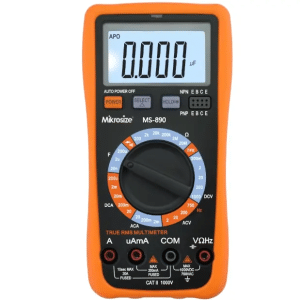
Product Features of Mikrosize MS-890
- Data hold: Freezes displayed values for easy recording while keeping probes connected to test points
- Backlight display: Enables clear reading under dim repair-bench lighting conditions
- Full-functions protection: Over-range and mis-operation protection across measurement modes, lowering risk of meter damage during repair work
- Auto power off: Automatically powers down after 15 minutes of inactivity to extend battery runtime
- Strong anti-magnetic and anti-interferential performance: Delivers stable readings in high-electromagnetic-noise workshop environments
- Unit symbol display: Direct visual marking of electrical units to reduce reading confusion
- Large LCD display: Enlarged screen area for quick, unambiguous value observation
- New-type holster, streamlined design, comfortable handle: Ergonomic form factor for long-time handheld operation on repair sites
Technical Specifications Table
|
Basic Function |
Range |
Accuracy |
|
DCV (DC Voltage) |
200 mV / 2 V / 20 V / 200 V / 1000 V |
± (0.5 % + 4) |
|
ACV (AC Voltage) |
2 V / 20 V / 200 V / 750 V |
± (0.8 % + 5) |
|
DCA (DC Current) |
200 μA / 2 mA / 20 mA / 200 mA / 20 A |
± (1.0 % + 5) |
|
ACA (AC Current) |
20 mA / 200 mA / 20 A |
± (1.5 % + 5) |
|
Resistance |
200 Ω / 2 kΩ / 20 kΩ / 200 kΩ / 2 MΩ / 20 MΩ |
± (0.8 % + 1) |
|
Capacitance |
20 nF / 2 μF / 200 μF |
± (3.5 % + 8) |
|
Frequency |
200 kHz |
± (0.5 % + 4) |
Frequently Asked Questions for Electronics Repair with Digital Multimeters
Q1: Why do I get fluctuating, unstable readings on my portable digital multimeter during PCB repair?
A: Unstable measurement outputs are usually caused by poor probe-tip contact, oxidized test points, low internal-meter battery voltage, or nearby electromagnetic interference from switching-mode power supplies. You can clean probe tips, secure probe contact, replace batteries, or move the test setup away from high-noise circuits. The MS-890’s built-in anti-magnetic and anti-interference design helps mitigate noise-caused drift in typical repair-shop environments.
Q2: What does “OL” / overload mean on a manual-range multimeter screen?
A: On manual-ranging multimeters, “OL” (overload) signals the measured value exceeds the currently selected measurement range. For resistance or continuity modes, it can also indicate an open circuit. Switch the rotary dial to a higher matching range before continuing your test.
Q3: Can I measure capacitors while they are still mounted on the circuit board?
A: In-circuit capacitance readings are often unreliable. Parallel resistors, inductors and other onboard components skew results. Always safely discharge capacitors before testing. For precise capacitance measurement, lift or remove at least one capacitor terminal from the PCB.
Q4: Why does my multimeter fuse blow during repair work?
A: The most common causes are measuring current while probes sit in voltage-measurement jacks, attempting to measure current higher than the meter’s rated current limit, or accidental short-circuit events under current mode. Replace blown fuses only with manufacturer-specified replacement fuses. The MS-890’s full-function protection reduces damage risk from frequent operator mistakes.
Q5: Is manual-range DMM suitable for everyday electronics repair?
A: Yes. Manual-range multimeters give technicians full control over measurement scales, which is helpful for observing subtle signal changes on known-approximate-value circuits. While auto-ranging meters save setup time, experienced repair technicians often prefer manual-range devices for repeatable, predictable bench-work on consumer electronics, power-supply boards and small-scale industrial circuits. 2000-count models offer sufficient resolution for most general-purpose fault-diagnosis tasks.
Conclusion
A qualified digital test multimeter forms the backbone of efficient electronics repair workflows. Repair-shop users should not only focus on raw accuracy numbers, but also weigh anti-interference robustness, safety-protection mechanisms, display usability and ergonomic build quality that match real-world bench-repair conditions. The Mikrosize company provides a full series of hand-held measuring instruments, among which the MS-890 2000 counts manual-range digital multimeter combines comprehensive core measurement functions, full-range protection and practical auxiliary features, perfectly serving electronics maintenance, appliance repair, laboratory quick-testing and hobby-circuit debugging scenarios. Selecting suitable Mikrosize test equipment helps repair teams obtain stable, repeatable measurement data and improve overall troubleshooting efficiency.
-150x150.jpg)