1.Material-Specific Selection Schemes for Main Samples (Compatible with 7 Polishing Cloths)
Classify by sample material, specify the 7 polishing cloth selections and suspension parameters for each polishing step, directly adapted to actual operation needs:
1.1 Ferrous Metals (Carbon Steel, Alloy Steel, Stainless Steel, Cast Iron)
- Carbon Steel/Alloy Steel
- Rough polishing: Canvas (non-nap, high cutting) + 6–15μm diamond suspension (quickly remove deep grinding marks
- Intermediate polishing: Nylon or Flocked (medium hardness, flat) + 3–6μm diamond/aluminum oxide suspension
- Fine polishing: Velvet or Silk (fine, low residue) + 0.5–1μm diamond + 0.05μm silicon dioxide (final mirror polishing)
Key points: Stainless steel is prone to pitting, replace suspension frequently during fine polishing; Cast iron is porous, prefer Canvas for rough polishing to prevent pore clogging via air permeability.
2.Stainless Steel
- Rough polishing: Nylon (wear-resistant, stable cutting) + 6–9μm diamond suspension
- Intermediate polishing: Flocked (flat nap, good cleanliness) + 1–3μm aluminum oxide suspension
- Fine polishing: Synthetic Polymer or Velvet (low residue, soft) + 0.3μm aluminum oxide + 0.05μm silicon dioxide (light pressure, short polishing time)
1.2 Non-Ferrous Metals (Aluminum, Copper, Magnesium, Titanium, Zinc Alloy)
- Aluminum/Aluminum Alloy (soft, sticky, prone to orange peel)
- Rough polishing: Nylon (coated type, reduces chip adhesion) + 3–6μm diamond suspension
- Intermediate polishing: Flocked (short nap, low cutting) + 1–3μm aluminum oxide suspension
- Fine polishing: Woolen or Velvet (ultra-soft, low-stress) + 0.3→0.05μm aluminum oxide (ultra-light pressure, speed ≤200rpm)
Key points: Use soft polishing cloths (Woolen, Velvet) throughout, low-pressure operation to avoid surface deformation and scratch embedding.
- Copper/Brass/Bronze (oxidizable, soft texture)
- Rough polishing: Flocked or Nylon (medium cutting, anti-chip adhesion) + 3–6μm diamond suspension
- Intermediate polishing: Velvet (fine, gentle) + 1–3μm diamond suspension
- Fine polishing: Silk or Synthetic Polymer (residue-free, anti-oxidation) + 0.05μm silicon dioxide (add corrosion inhibitor, intermittent polishing)
- Magnesium Alloy (ultra-soft, oxidizable)
- Rough polishing: Canvas (air permeable, high cutting) + 6–9μm diamond suspension (weak alkaline environment)
- Fine polishing: Woolen (low-stress, anti-oxidation) + 0.05μm silicon-aluminum mixed suspension (pH≈9)
- Titanium Alloy (medium-hard, prone to work hardening)
- Rough polishing: Nylon or Canvas (hard, high cutting) + 6–9μm diamond suspension
- Fine polishing: Synthetic Polymer (adjustable hardness, low heat input) + 1–3μm diamond suspension (low-speed operation)
1.3Cemented Carbide and Ceramics (WC, Al₂O₃, Si₃N₄, ZrO₂)
- Cemented Carbide (ultra-hard, wear-resistant)
- Rough polishing: Canvas or Nylon (hard, high cutting) + 9–15μm diamond suspension
- Intermediate polishing: Flocked (flat, medium cutting) + 3–6μm diamond suspension
- Fine polishing: Silk or Synthetic Polymer (non-nap, low residue) + 0.5–1μm diamond + 0.05μm aluminum oxide
Key points: Use hard polishing cloths (Canvas, Nylon), medium-high pressure operation, extend rough polishing time to ensure material removal efficiency.
- Engineering Ceramics (Al₂O₃, ZrO₂, SiC)
- Rough polishing: Canvas (high wear resistance, air permeable) + 20–45μm diamond suspension
- Intermediate polishing: Nylon (high cutting, stable) + 6–9μm diamond suspension
- Fine polishing: Synthetic Polymer (flat, low residue) + 1–3μm diamond + 0.05μm silicon dioxide (CMP process)
1.4 Polymers and Composites (ABS, PC, Epoxy, Glass Fiber/Carbon Fiber Composites)
- Thermoplastics (ABS, PC, PMMA)
- Rough polishing: Flocked or Velvet (soft, low cutting) + 3–6μm diamond suspension (temperature control <70% of sample softening point)
- Fine polishing: Woolen or Synthetic Polymer (low-stress, anti-softening) + 0.05–0.5μm aluminum oxide/silicon dioxide (low pressure, low speed)
- Thermosets (Epoxy, Phenolic)
- Intermediate polishing: Flocked (flat, low cutting) + 1–3μm diamond suspension
- Fine polishing: Silk or Synthetic Polymer (residue-free, anti-edge rounding) + 0.05–0.3μm silicon dioxide
- Composites (Glass Fiber, Carbon Fiber, Metal Matrix)
- Rough polishing: Canvas or Nylon (high cutting, wear-resistant) + 6–9μm diamond suspension
- Fine polishing: Velvet or Synthetic Polymer (interface protection, low damage) + 0.5–1μm diamond + 0.05μm aluminum oxide
1.5 Semiconductors and Electronic Materials (Silicon, Germanium, PCB, Coating)
- Silicon/Germanium Wafer (ultra-precision, damage-free)
- Rough polishing: Nylon or Flocked (medium cutting, flat) + 3–6μm diamond suspension
- Fine polishing: Silk or Synthetic Polymer (non-nap, residue-free) + 0.02–0.05μm colloidal silicon dioxide (CMP, pH≈10)
- PCB/Coating (copper, nickel, gold coating, soft and thin)
- Intermediate polishing: Flocked (soft, low cutting) + 0.5–3μm diamond suspension
- Fine polishing: Velvet or Synthetic Polymer (ultra-soft, anti-falling off) + 0.05–3μm aluminum oxide (ultra-light pressure)
2.Quick Reference Table for 7 Polishing Cloths and Suspension Compatibility
| Polishing Cloth Material | Material Properties | Compatible Suspension Particle Size | Typical Applicable Samples | Polishing Stage |
| Canvas | Non-nap, wear-resistant, high air permeability, hard | 5~14μm | Carbon steel, cast iron, cemented carbide, ceramics | Rough polishing |
| Nylon | High density, medium-hard, wear-resistant, tear-resistant | 7~20μm(rough)、1~6μm(intermediate) | Ferrous metals, non-ferrous metals, ceramics | Rough, intermediate |
| Flocked | Short nap, flat, medium-hard, good cleanliness | 1~3μm | Stainless steel, aluminum, copper, polymer | Intermediate, partial fine |
| Velvet | Soft, short nap, fine, low-stress | 0.5~5μm (intermediate, fine) | Aluminum, copper, soft metals, polymer | Intermediate, fine |
| Woolen | Ultra-soft, slightly long nap, low-stress, air permeable | 3~5μm | Aluminum, magnesium alloy, polymer | Fine, final |
| Silk | Fine, non-nap, soft, residue-free | 0.5~3.5μm (intermediate, fine) | Cemented carbide, semiconductors, precision metals | Fine, final |
| Synthetic Polymer | Fine, non-nap, soft, residue-freeAdjustable hardness, flat, non-nap, low residue | 0.02~1μm | Semiconductors, ceramics, precision metals, composites | Intermediate, fine, final |
3.Quick Reference Table for Suspension Types and Applicable Scenarios
| Suspension Type | Typical Particle Size | Advantages | Applicable Materials |
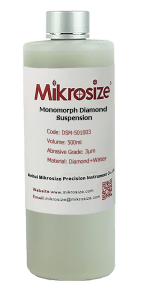
| Diamond | 0.5–15μm | Strong cutting force, high efficiency, wear-resistant | Steel, cemented carbide, ceramics, titanium alloy |
| Aluminum Oxide (Al₂O₃) | 0.05–3μm | High versatility, low cost, residue-free | Ferrous metals, aluminum, magnesium, polymer |
| Silicon Dioxide (SiO₂) | 0.02–0.05μm | Chemical-mechanical polishing, excellent mirror effect | Copper, semiconductors, glass, precision samples |
| Silicon-Aluminum Mixed | 0.05μm | Weakly alkaline, anti-oxidation, gentle | Magnesium alloy, ferrous alloy, oxidizable metals |
4.Key Practical Operation Points
-
- Gradient Polishing: Strictly follow “rough → intermediate → fine” to reduce particle size step by step. Completely remove scratches from the previous step at each stage, prohibit cross-level polishing to avoid deep scratch residue that is difficult to remove.
- Pressure and Speed Control: Medium-high pressure, medium speed (800–1200rpm) for hard samples (ceramics, cemented carbide); Low pressure, low speed (≤5N, ≤200rpm) for soft samples (aluminum, polymer); Light pressure and short time (≤1 minute) throughout fine and final polishing.
- Cleaning and Cloth Replacement: Replace polishing cloth or thoroughly clean the cloth surface after each polishing stage to prevent coarse particles from entering fine polishing; Soft cloths such as Velvet and Woolen need regular replacement to avoid fiber shedding contaminating the sample surface.
- Special Protection: Add corrosion inhibitor to suspension when polishing oxidizable samples (copper, magnesium); Control polishing temperature for polymer samples to avoid softening deformation; Use anti-static polishing cloth (e.g., Synthetic Polymer) and ultra-pure suspension for semiconductor samples to eliminate impurity contamination.
5.Summary
In actual operation, adjust the selection slightly according to the sample’s specific hardness and observation requirements (metallographic, SEM, optical): Prefer Canvas, Nylon for hard samples; Velvet, Woolen, Silk for soft samples; Silk, Synthetic Polymer for precision samples. Adjust the suspension step by step following the principle of “coarse particle size for rough polishing, fine particle size for fine polishing” to obtain stable and qualified polishing results.
-150x150.jpg)