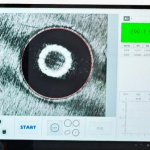
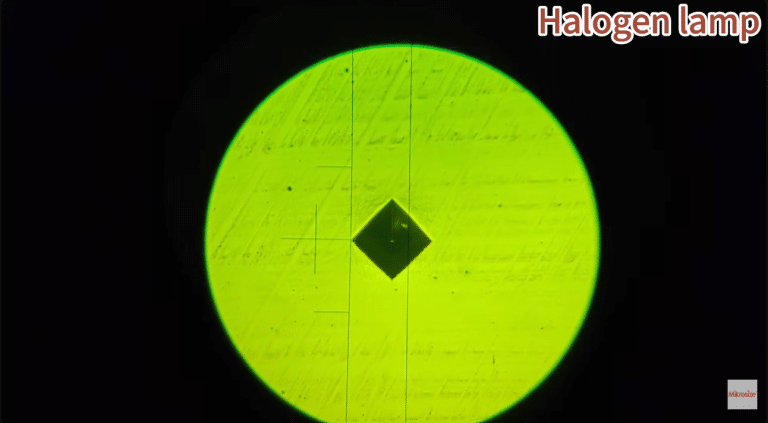
In Vickers and Brinell hardness testing, the indentation is everything. The operator measures two diagonals on a magnified image, and the reading is only as good as the edge he can see. If the indentation outline is soft, uneven, or washed out, the diagonal measurement drifts, and the same sample tested twice gives two different numbers.
That is why hardness tester illumination is not a minor accessory. It decides whether your indentation edge contrast is sharp enough for reliable measurement. The two options on most benches today are halogen lamps and LED cold light sources, and they behave quite differently.
Why the light source affects measurement accuracy
A hardness tester’s optics can only resolve what the illumination delivers. Two things matter:
- Edge contrast. The boundary between the indentation wall and the polished surface must be clearly separated in brightness.
- Stability over time. If brightness or color temperature shifts, the image shifts with it, and so does the measurement.
Heat is the hidden factor here. Any light source that warms the optical path can move the focal plane slightly, which shows up as focus drift in hardness testing during long inspection runs.
Halogen lamps: continuous spectrum, high color fidelity
A halogen lamp for hardness testers produces a continuous spectrum with a color rendering index close to 100. In practice this means the indentation contour looks natural, with layered shading along the walls and a clean transition at the rim. Under coaxial or ring illumination, the result is close to what the eye expects.
This makes halogen a reasonable choice for:
- Manual eyepiece reading on a Vickers hardness tester, where the operator judges the edge by eye
- Samples where color fidelity helps distinguish phases, coatings, or etched structures
- Labs already built around a traditional optical setup
The trade-offs are real. Halogen output is hot, so thermal drift of optical components becomes a concern in long sessions. Bulb life is limited, brightness decays gradually with age, and the lamp has to be replaced on a schedule to keep image consistency across batches. Anyone who has run a microhardness tester halogen lamp for years knows the drill: warm up, re-focus, and watch for the day the image starts to look tired.
LED illuminators: stable, cool, built for automated measurement
A LED illuminator for hardness testers runs cold. Heat output is negligible, so thermal interference on the focal plane drops away, and the measurement stays put through a full shift.
LED life reaches tens of thousands of hours, brightness and color temperature hold steady, and there is almost no maintenance. For a lab running continuous batch hardness inspection, that reliability matters more than the last bit of color warmth.
There is a common objection worth answering directly: do LEDs give flatter, less readable indentations? Not with good components. A high-CRI LED hardness tester light paired with a properly matched optical design produces sharp edges and strong contrast, and it is particularly friendly to CCD/CMOS automatic measurement and image processing algorithms. The indentation edge becomes a clean gradient the software can threshold without guessing.
The risk sits at the low end of the market. Cheap LEDs with a spiky spectrum can leave insufficient edge contrast, especially on polished or lightly etched surfaces. When specifying an LED light source for Vickers hardness testing, check the spectral match to the camera and the optics, not just the lumen output.
Halogen vs LED: side-by-side
Factor | Halogen | LED |
Spectrum | Continuous, CRI near 100 | Narrow-band, quality depends on CRI |
Heat output | High | Very low |
Focus stability | Drifts with heat | Stable through long runs |
Lifespan | Short, needs replacement | Tens of thousands of hours |
Brightness consistency | Decays with age | Holds steady |
Best fit | Manual eyepiece reading, colour-sensitive samples | Automated measurement, batch inspection |
How to choose for your bench
Both sources produce a measurable indentation image when the optical system is designed properly. The decision comes down to how the tester is actually used.
Choose halogen if reading is manual, the sample benefits from true color reproduction, and someone on the team already manages lamp replacement and warm-up routines.
Choose LED if the tester runs with a CCD/CMOS camera and automatic measurement software, if throughput is high, or if maintenance cost of hardness tester lighting is a line item you want to cut.
For mixed use, a dual-configuration instrument is the practical answer. You keep the halogen look for the samples that need it and run LED for routine volume work.
Q&A
Q: Does switching from halogen to LED change my hardness readings?
A:Not if the edge contrast stays sharp and the optics are matched. What can change is the image appearance. Re-verify with a certified test block after the swap and confirm the diagonal measurement is unchanged.
Q: Is LED illumination accurate enough for Vickers hardness testing?
A:Yes, provided the LED has good color rendering and a spectrum matched to the camera. Sharp indentation edges and stable brightness are what the measurement needs, and quality LEDs deliver both.
Q: Will halogen heat really affect measurement accuracy?
A:Over long sessions, yes. Heat warms the optical path and can shift the focal plane slightly, which shows up as focus drift. This is most visible in extended batch testing rather than short individual readings.
Q: How often should a halogen bulb be replaced?
A:Follow the manufacturer’s rated hours, and replace earlier if you notice dimming or a color shift. Consistency between batches matters more than squeezing the last hours out of a bulb.
Q: Can I retrofit an LED illuminator onto an existing hardness tester?
A: Often yes, but the retrofit has to match the original optical design and camera. An unmatched LED can reduce edge contrast instead of improving it, so specify the module with the tester model in hand.
Q: Which light source is better for automated hardness testing systems?
A:LED. Low heat, stable output and long life suit continuous automated operation, and the steady image helps CCD/CMOS algorithms find the indentation edge reliably.
Conclusion
Illumination is a measurement variable, not a cosmetic detail. Halogen gives you continuous spectrum and near-perfect color rendering, at the cost of heat, short bulb life and gradual brightness decay. LED gives you stable brightness, low thermal interference and long service life, with edge quality that depends on choosing a high-CRI, well-matched module rather than the cheapest option on the shelf.
Mikrosize builds hardness testers with both halogen and LED illumination configurations, so the light source can be matched to how the instrument is actually used: manual eyepiece reading, camera-based automatic measurement, or a mix of both. If you are specifying a new tester or upgrading the illumination on an existing bench, the team can help you match the light source to your optics, camera and sample types, and confirm the setup against certified test blocks before it goes into routine use.