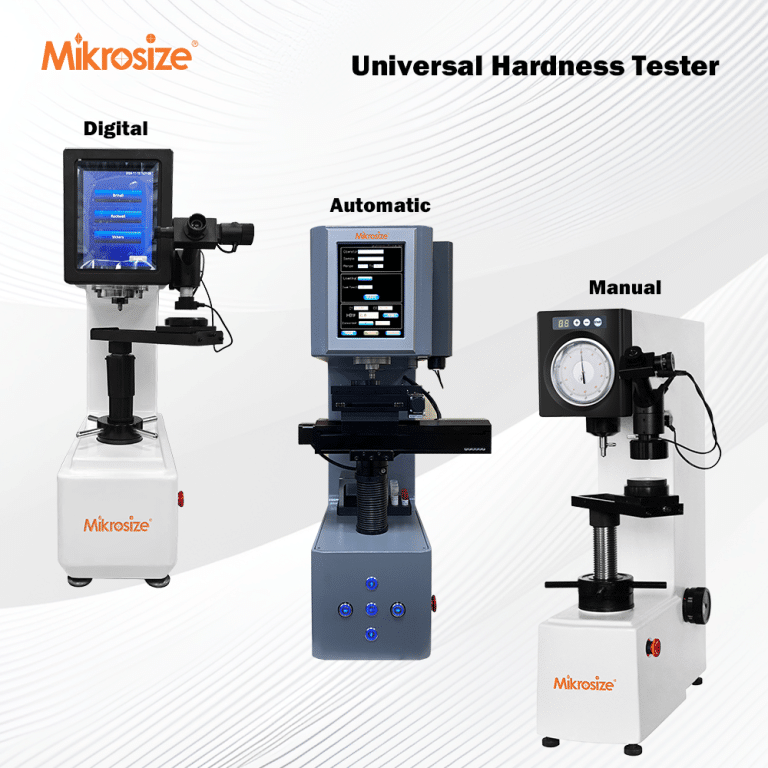
The universal hardness tester is a professional instrument designed to measure material hardness. It supports multiple testing methods—such as Rockwell, Brinell, and Vickers—and is utilized in precision manufacturing and quality control sectors, including the production of aero-engine components and automotive parts. These instruments typically feature capabilities such as an automatic turret for switching between indenters and objective lenses, a closed-loop load control system, and a high-definition optical measurement system. The Mikrosize MBRV-250A model, specifically, incorporates innovative optical zoom technology.
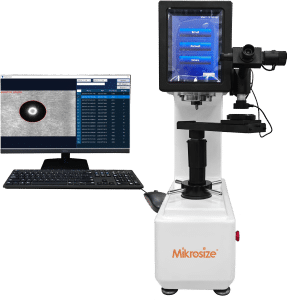
Core Technology
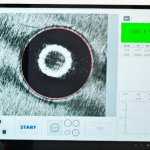
The technical core of universal hardness testers lies in the integration of automation, high-precision measurement, and standardization capabilities. Key features include an automatic turret for switching between indenters and objective lenses, a closed-loop load control system, and a high-definition optical measurement system. The automatic turret and multi-mode integration system enable rapid switching between various indenters (such as Rockwell, Brinell, and Vickers) and optical objectives, supporting seamless testing across multiple hardness scales. These devices utilize closed-loop load control and offer a wide testing range; a closed-loop sensor control system manages programmable, automatic load application, dwell, and unloading to ensure precise and stable force application, covering a test force range from 1 kgf to 3000 kgf. The high-precision optical measurement and image analysis systems incorporate high-definition zoom optics—such as 5-megapixel cameras with digital zoom and autofocus, or the optical system providing magnification from 0.7x to 1000x. Combined with fully automated indentation image analysis algorithms, these systems enable rapid, accurate measurement of indentations with precision reaching 0.1 μm. Regarding standardization and compatibility, the equipment is designed to meet or exceed international standards such as those from the International Organization for Standardization (ISO), ASTM International, and Japanese Industrial Standards (JIS), ensuring the global comparability and reliability of test results.
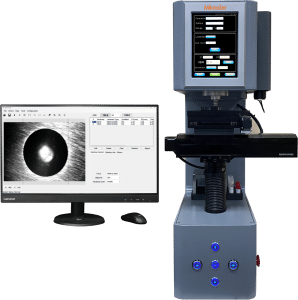
Typical Technical Specifications
Load ranges span from 1 kgf to 250 kgf. Turret configurations typically feature 6 or 8 automatic positions . Optical systems generally utilize high-definition cameras (5 megapixels or higher) equipped with zoom objectives or single variable-zoom objectives; some models, to achieve image magnifications ranging from 0.7x to 1000x.
Indenter types typically include Brinell ball indenters (e.g., 1 mm, 2.5 mm, 5 mm, 10 mm), Rockwell diamond indenters (120°), Vickers diamond indenters (136°), and Rockwell ball indenters (e.g., 1/16″, 1/8″, 1/4″, 1/2″). Compliance extends to international standards such as ISO 6506 (Brinell), ISO 6507 (Vickers), ISO 6508 (Rockwell), and ASTM E10, E18, and E92, as well as Chinese national standards (GB/T series). Regarding maximum specimen dimensions and weight, common specifications include a maximum specimen height of approximately 300 mm and a maximum load capacity of around 70 kg (e.g., 300 mm/70 kg for the UH4000 series and 300 mm for the NEMESIS 9000). Equipment dimensions typically range from approximately 400 mm × 650 mm × 1440 mm to 704 mm × 534 mm × 995 mm, with power requirements generally set at 100–240 VAC, 50–60 Hz.
-150x150.jpg)