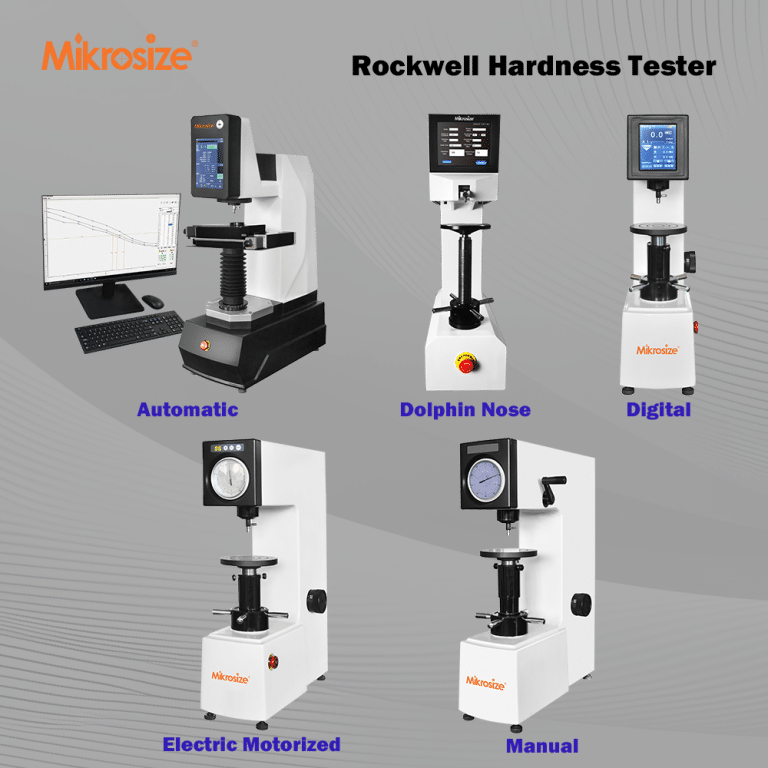
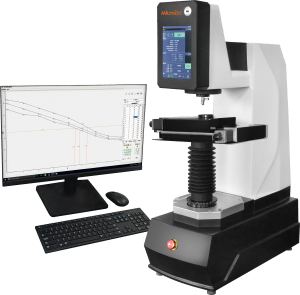
The Rockwell hardness tester is the first in the world designed based on the Rockwell hardness testing principle—capable of testing metal hardness through contact with only one side of the specimen. It utilizes magnetic force to attach the probe to steel surfaces, eliminating the need for specimen support while maintaining performance comparable to benchtop models. The Rockwell hardness testing method was originally proposed by Americans S.P. Rockwell and H.M. Rockwell in 1914. Subsequent design improvements in 1919 and 1921 established the prototype for modern Rockwell hardness testers. In 1930, C.H. Wilson introduced an updated design, further refining both the testing method and the equipment. Mikrosize now manufactures Rockwell hardness testers featuring touchscreen controls, digital and curve displays, and automatic data printing capabilities. Key characteristics of the Rockwell method include ease of operation and rapid test, with direct readings available via a dial indicator, optical projection screen, or digital display. Like the Brinell and Vickers methods, it is one of the three most widely used hardness testing techniques.

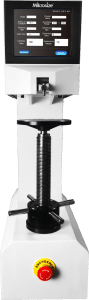
Rockwell Hardness Tester Feature
1.The same testing principles and accuracy; complies with GB/T230, ISO6508, and ASTM E110 standards; verified by the National Institute of Metrology (China) with an error margin of no more than 1.5 HRC.
2. Rapid testing, simple, and non-destructive.
3.Equipped with a micrometer-style reading mechanism for easy reading, excellent repeatability, and high precision.
4.Includes an illuminated magnifier to ensure easy reading in dimly lit workshop environments.
5.Capable of testing flat workpieces as well as curved surfaces with ranging from Φ50mm to infinity.
6.Suitable for precise on-site testing of steel plates, pipes, shafts, molds, large forgings, and various large-to-medium heat-treated, surface-hardened, or assembled components; particularly ideal for testing the hardness of weld seams and heat-affected zones.
7.Suitable for production and acceptance inspections; serves as a high-precision alternative to lower-accuracy Leeb hardness testers.
8.Uses traceable standard rockwell hardness blocks.
9.Uses indenters verified against standard Rockwell hardness testers.
10. Uses force-measuring instruments for test force calibration that are traceable to national secondary standards.
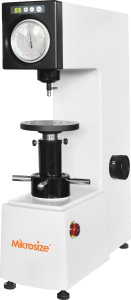
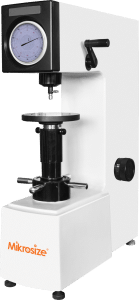
Product Categories:
1.By application: Rockwell, superficial Rockwell, and fully Rockwell hardness testers;
2.By operation method: manual and motorized Rockwell hardness testers;
3.By display method: analog (dial) and digital Rockwell hardness testers;
4.By loading method: lever-based dead-weight loading and closed-loop loading using a motor and sensor;
5.By reference platform: manual platform, moving-platform automatic, and moving-head automatic Rockwell hardness testers.
-150x150.jpg)