The Vickers hardness test method was proposed by R.L. Smith and G.E. Sandland in UK in 1921, and the British company Vickers-Armstrongs developed the first hardness tester utilizing this method. The Vickers hardness tester is a high-tech product integrating optics, mechanics, and electronics; featuring a novel design, excellent reliability, ease of operation, and intuitive functionality, it represents a new generation of Vickers and Knoop hardness testing instruments that employ precision mechanical and optoelectronic technologies.
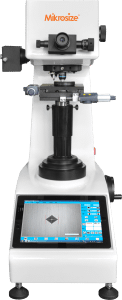
Vickers hardness testers offer a wide range of test forces, making them suitable for testing any workpiece provided its surface roughness meets the required standards. The tester uses a stepper motor to apply force to the workpiece surface, after which a reading microscope is used to measure the diagonal lengths of the resulting indentation. The Vickers hardness value is then determined based on the relationship between the diagonal lengths and the applied test force. Additionally, Vickers hardness test software can be installed to display images on a computer screen, making the test process more convenient and efficient.
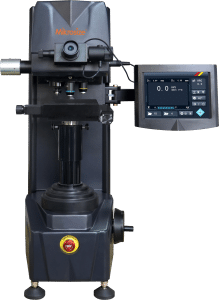
Application:
The Vickers hardness test is mainly used for small-load Vickers hardness tests in materials research and scientific experiments. It is mainly used to test the hardness of small precision parts, the hardness of the surface hardened layer and the depth of the effective hardened layer, the surface hardness of the coating, the hardness of sheet materials and thin wires, the hardness near the blade, the hardness of dental materials, etc. Since the test force is very small and the indentation is very small, the appearance and performance of the sample are not affected. Micro Vickers hardness test is mainly used in metallurgical and metallographic research, used to measure the hardness of each component phase in the metal structure, and used to study the brittleness of refractory compounds, etc. Micro Vickers hardness test is also used to test extremely small or extremely thin parts, and the thickness of the parts can be as thin as 3μm.
It is widely used to measure the microhardness of tiny, thin specimens, surface coatings and other specimens and to determine the Knoop hardness of brittle and hard materials such as glass, ceramics, agate, artificial gemstones, etc. It is an ideal hardness testing instrument for scientific research institutions, factories and quality supervision departments to conduct material research and testing. Scope of application: heat treatment, carbonization, quenching hardened layer, surface coating, steel, non-ferrous metals and small and thin parts, etc. Equipped with a Knoop indenter, it can measure the Knoop hardness of brittle and hard materials such as glass, ceramics, agate, and artificial gemstones.
Test Principle
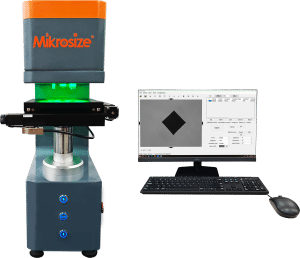
The Vickers hardness tester operates by pressing a square-based diamond pyramid indenter—with an included angle of 136° between opposite faces—into the material surface using a load ranging from 49.03 N to 980.7 N. After maintaining the load for a specified duration, the lengths of the indentation diagonals are measured, and the hardness value is calculated using a specific formula. This method is suitable for measuring the hardness of large workpieces and deep surface layers. Variants include “low-load Vickers hardness” (test load < 49.03 N), suitable for thin workpieces, tool surfaces, or coatings; and “micro-Vickers hardness” (test load < 1.961 N), suitable for metal foils and extremely thin surface layers.
The Vickers hardness value is defined as the quotient of the test force divided by the surface area of the indentation. The calculation formula is: HV = Constant × Test Force / Indentation Surface Area ≈ 0.1891 F/d² … where HV represents the Vickers hardness symbol, F is the test force (in N), and d is the arithmetic mean of the two indentation diagonals d1 and d2 (in mm). In practice, the Vickers hardness value is obtained by looking up the diagonal length d in a reference table. National standards specify an indentation diagonal length range of 0.020 to 1.400 mm. Please refer to the diagram above illustrating the testing principle of the Vickers hardness tester.
Technical Feature
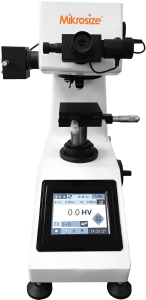
This fully computerized Vickers hardness tester is a state-of-the-art instrument for Vickers and Knoop hardness testing, integrating precision mechanics, optoelectronics, image processing technology, and specialized material hardness analysis software. Featuring a modern design and microprocessor control, the instrument allows for adjustments such as light source intensity and dwell time via a soft-key interface, as well as switching between Vickers and Knoop test methods and managing file storage. A large LCD screen displays test parameters—including test method, load, indentation diagonal length, hardness value, dwell time, and measurement count—and supports date entry; test results can be output via a built-in micro-printer or transmitted to a computer through an RS232 interface. Hardness values are read directly from the screen after inputting the indentation diagonal length, eliminating the need for tedious lookup tables. The instrument utilizes a unique mechanism for indentation measurement conversion and direct reading via a micrometer eyepiece, ensuring ease of use and high measurement accuracy. An automatic turret mechanism further automates the testing process, enhancing speed and efficiency. Additionally, the system supports the imaging, data analysis, and evaluation of indentations and material microstructures, making the entire testing process more convenient and efficient.
Different types of vickers hardness tester
1. By applied force:
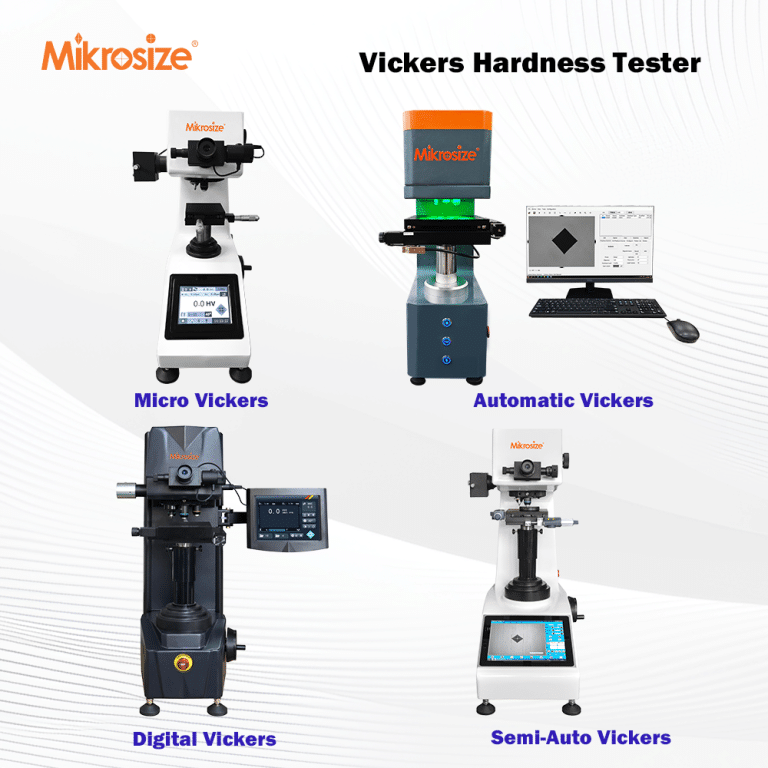
(1)Micro-hardness tester: Refers to a Vickers hardness tester that applies a force of less than 2 kg
https://mikrosize.com/products/hardness-tester/micro-vickers-hardness-tester/
(2)Vickers hardness tester: Refers to a Vickers hardness tester that applies a force greater than 2 kg but less than 120 kg
https://mikrosize.com/products/hardness-tester/macro-vickers-hardness-tester/2. By the method of applying the test force:
(1)Dead-weight loading Vickers hardness testers
(2)Electronic sensor loading Vickers hardness testers
3. By test display method:
(1)Standard Vickers hardness tester
(2)Digital display Vickers hardness tester
(3)Automatic turret Vickers hardness tester
(4)Digital display automatic turret Vickers hardness tester
https://mikrosize.com/product/mvicky-10-50-macro-vickers-hardness-tester
(5)Full-function Vickers hardness tester
https://mikrosize.com/product/mvision-1-10-30-50-intelligent-semi-auto-vickers-hardness-tester/
(6)Vickers hardness measurement and analysis system
https://mikrosize.com/product/uvicky-10-30-50ai-intelligent-automatic-macro-vickers-hardness-tester
-150x150.jpg)