-3-768x1303.jpg "How to Choose Auxiliary Objective Lenses for Stereo Microscopes 1")
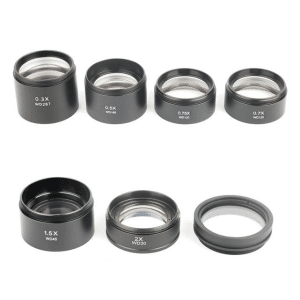
Auxiliary objective lenses, also known as zoom extender lenses, are essential optical accessories for stereo microscopes. Widely used in electronic component inspection, precision parts processing, circuit board maintenance, and biological research, they effectively adjust the microscope’s magnification and working distance to optimize imaging clarity and operational flexibility. Many users only focus on magnification during selection, leading to inappropriate purchases. This guide simplifies the selection logic, covering working principles, common magnifications with application scenarios, and frequently asked questions to help beginners make accurate choices.
1. Working Principle of Auxiliary Objective Lenses
Auxiliary objective lenses are installed below the main objective lens of a stereo microscope, with two core adjustable functions that determine the overall observation effect and operability.
Magnification Adjustment: The lens magnification is directly superimposed on the main objective lens to change the final observation magnification. Low-magnification lenses reduce the overall magnification for a wider field of view, while high-magnification lenses boost magnification to capture tiny sample details. For example, a 10X main objective matched with a 0.5X auxiliary lens delivers 5X total magnification, while a 2X auxiliary lens achieves 20X total magnification.
Working Distance Adjustment: Working Distance (WD) refers to the vertical space between the lens and the sample, a key factor for manual operations. Low-magnification auxiliary lenses increase the working distance, reserving enough space for welding, disassembly and other operations; high-magnification lenses shorten the working distance for high-precision close observation. Common specifications like WD165 and WD30 represent different standard working distances for diverse application needs.
2. Common Magnifications and Application Scenarios
There is no universal magnification for all scenarios. The optimal choice depends on sample characteristics and operational demands. The table below summarizes mainstream magnifications, working distance features and typical use cases for quick reference.
|
Auxiliary Lens Magnification |
Working Distance Feature |
Core Advantages |
Typical Application Scenarios |
|
0.5X |
Longest working distance |
Widest field of view, ample operating space |
Large/thick samples, circuit board overall inspection, batch sample screening, welding and disassembly operations |
|
0.7X |
Slightly increased working distance |
Balanced field of view and basic detail observation |
Daily industrial detection, medium-sized precision parts inspection, routine biological sample observation |
|
1.5X |
Shortened working distance |
Improved detail resolution, moderate magnification |
Fine inspection of small electronic components, surface defect detection of precision parts |
|
2.0X |
Shortest working distance |
Highest magnification, ultra-fine detail capture |
Micro-structure observation, tiny crack detection, high-precision scientific research analysis |
3. Frequently Asked Questions (QA)
Q1: Is higher magnification always better?
A1: No. Excessively high magnification reduces the working distance and field of view, limiting manual operation space and failing to adapt to large or thick samples. Always balance magnification, working distance and actual application needs instead of pursuing high parameters blindly.
Q2: When is a long working distance auxiliary lens necessary?
A2: It is required if you need to perform manual operations (welding, trimming, disassembly) during observation, or observe thick, multi-layered and large-size samples. A long working distance avoids lens collision with samples and ensures smooth operation.
Q3: Can multiple auxiliary lenses be used simultaneously?
A3: It is not recommended. Stacking multiple lenses will severely reduce imaging clarity, cause optical distortion, and sharply shorten the working distance, greatly affecting observation and use effect.
Q4: Will the auxiliary lens affect image quality?
A4: High-quality standard lenses have negligible impact on imaging. Low-cost inferior lenses may cause distortion, blurriness or chromatic aberration. Prioritize high-quality lenses to ensure observation accuracy.
Q5: What key points should be confirmed before purchase?
A5: First, confirm the sample’s size, thickness and structural characteristics; second, clarify the required magnification and working distance; finally, verify lens compatibility with your microscope and match the product with your budget.
4.Conclusion
The key to selecting auxiliary lenses for stereo microscopes is demand matching. Choose low-magnification, long-distance lenses for operational observation with a stereo microscope, and high-magnification lenses for ultra-fine detail detection. Proper matching effectively avoids pitfalls and maximizes your stereo microscope’s performance.
-150x150.jpg)