In daily precision inspection and experimental work with a stereo microscope, lighting is never a trivial accessory. The LED ring light serves as the core lighting source for a stereo microscope, directly determining imaging quality, detail recognition accuracy and overall observation efficiency. Many users focus only on the lens and magnification of a stereo microscope but ignore the importance of matching ring lights. An improper ring light will cause serious problems such as surface reflection, inappropriate color temperature, insufficient brightness and uneven illumination, completely ruining the observation effect of the stereo microscope. This article comprehensively explains the selection methods, core parameters, application skills and common pitfalls of LED ring lights for stereo microscope users, helping you pick the most suitable lighting equipment.
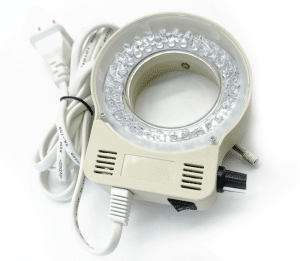
1.Why Does a Stereo Microscope Need an LED Ring Light?
A stereo microscope is mainly used for observing three-dimensional surface structures, covering industrial circuit board inspection, precision parts detection, jewelry inlay processing and biological sample observation. Most observed samples are opaque or have complex curved surfaces, and the built-in ambient light of a stereo microscope cannot provide sufficient and uniform reflected light. Without auxiliary lighting, it is difficult to capture tiny surface details and structural features.
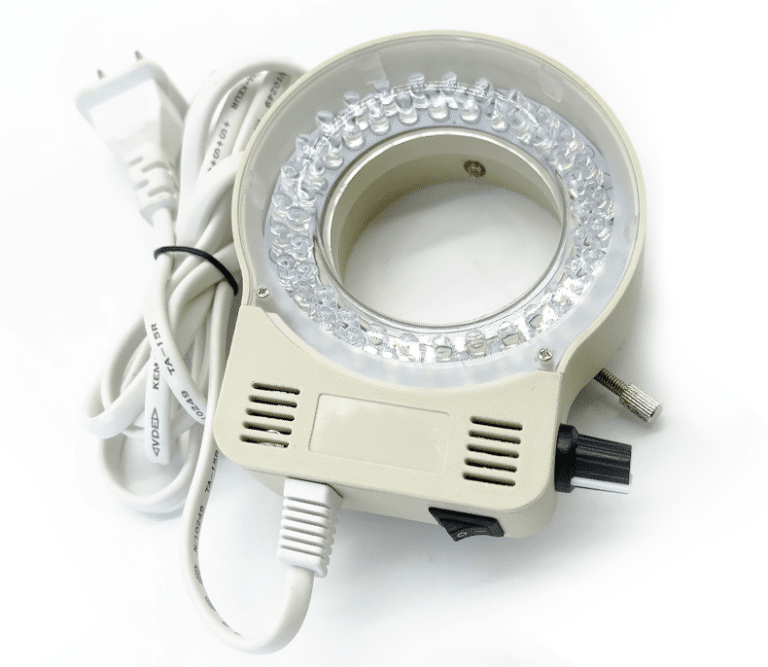
As the mainstream supporting lighting solution for a stereo microscope, the LED ring light features uniform illumination, easy installation, low energy consumption and stable performance. It provides soft and standard white light for observation, effectively eliminating shadows and local dark areas. Meanwhile, a professional LED ring light can perfectly match CCD industrial cameras equipped on a stereo microscope, greatly improving image contrast, detail hierarchy and color restoration, and ensuring high-precision image acquisition and detection analysis.
2.Core Parameters for Choosing a Stereo Microscope LED Ring Light
When purchasing an LED ring light for a stereo microscope, do not blindly pursue high brightness. You need to comprehensively evaluate multiple core parameters to match your observation scenarios. The key selection indicators are as follows:
- Color Temperature
The recommended color temperature range is 5000K to 6000K (cool white light). This parameter is close to natural light, which can restore the real color of samples without color deviation, and is very suitable for industrial inspection and biological observation with a stereo microscope. Too high or too low color temperature will cause image color cast and affect detection accuracy.
- Brightness Adjustability
It is essential to choose a ring light with stepless dimming function. Different samples have different light reflection characteristics: high-gloss samples are prone to reflection with strong light, while matte samples require sufficient brightness to display details. Adjustable brightness allows the stereo microscope to adapt to various sample types and observation environments.
- Installation Interface Compatibility
Confirm that the ring light aperture size matches the objective lens diameter of your stereo microscope. Common standard sizes include Φ52mm and Φ59mm. Mismatched sizes will lead to unable installation, shaking or light leakage, which affects the stability of long-term use.
- Light Uniformity
High-quality LED ring lights adopt dense and uniform lamp bead layout, which can achieve 360° no-dead-angle lighting for the stereo microscope. Inferior products have uneven light distribution, resulting in local bright spots or shadows, interfering with detail observation.
- Heat Dissipation and Service Life
Industrial-grade ring lights have a service life of more than 30,000 hours, with professional heat dissipation structures. Long-term continuous observation with a stereo microscope will not cause light attenuation or equipment overheating, ensuring stable long-term work.
- Anti-strobe and Synchronization Performance (for CCD camera users)
If your stereo microscope is matched with a CCD industrial camera for high-speed shooting and image acquisition, it is necessary to select a ring light with low-frequency strobe control and synchronous trigger function to avoid frame skipping and image blurring.
3.Frequently Asked Questions
Q1: Is the dimming function necessary for a stereo microscope fill light?
A1: Absolutely necessary. Stepless brightness adjustment allows the stereo microscope to flexibly adapt to samples of different materials, glossiness and thickness, effectively avoiding overexposure or insufficient light and greatly improving imaging clarity.
Q2: Can the LED ring light work with industrial cameras?
A2: Yes. It is recommended to select a professional industrial ring light with synchronous trigger and anti-strobe functions. It can cooperate with the stereo microscope and CCD camera to complete stable high-speed image collection and meet high-precision detection needs.
4. Conclusion
The LED ring light is a decisive supporting accessory for the stereo microscope. When selecting, you must comprehensively consider color temperature, brightness adjustability, interface compatibility and heat dissipation performance, instead of simply pursuing high brightness. Reasonable lighting matching can maximize the imaging performance of the stereo microscope and greatly improve the efficiency and accuracy of inspection and experimental work.
-150x150.jpg)