The booming new-energy electric vehicle industry places lithium-ion batteries at the core of vehicle performance. Battery safety, driving range, and overall reliability heavily depend on rigorous micro-level inspection, material characterization and failure diagnostics throughout R&D and mass-production workflows. As high-precision metrology instruments, industrial microscopes serve as irreplaceable quality-control tools across battery material development, cell production, and post-mortem failure analysis. This blog explores core use cases of industrial microscopy within battery manufacturing, alongside advanced hardware solutions from high-tech equipment supplier Mikrosize.
Key Application Scenarios of Industrial Microscopes in Battery Production
Modern industrial microscopes support non-destructive material testing, in-line quality assurance and battery failure root-cause analysis, covering every critical stage from raw-material screening to finished-module validationLeica Micr….
1. Battery Raw-Material Microstructure Analysis for R&D Optimization
During battery material research and formulation development, industrial microscopes deliver detailed morphological and structural observation for lithium-based compounds, cathode-anode active powders, separator films and coating layers. Engineers rely on microscope imaging to evaluate particle shape, surface texture, impurity inclusions and coating uniformity, which guides material-formula iteration and performance tuning. Common search scenarios include how to observe battery electrode material morphology under industrial microscope, microstructure characterization for lithium-ion battery separators, and microscopic evaluation of cathode-anode powder qualityHitachi Hi…. These microscopic insights help R&D teams pick better raw materials and reduce trial-and-error cycles for new-generation battery chemistries.
2. In-Process Quality Control for Battery Cells and Modules
Consistent manufacturing quality directly prevents thermal runaway risks and capacity inconsistency in finished battery packs. Industrial microscopes often work together with X-ray and CT scanning systems to implement high-precision non-destructive inspection for battery cells and assembled modules. It detects typical production defects: electrode burrs, coating delamination, foreign particle contamination, separator damage and internal assembly misalignment. Popular long-tail search terms cover industrial microscope for lithium-ion battery in-line QC inspection, non-destructive microscopic testing for EV battery modules, and micro defect detection in battery electrode sheetsLeica Micr…. Continuous microscopic monitoring stabilizes production yield and guarantees uniform performance among mass-produced battery units.
3. Post-Service Battery Failure Diagnosis & Aging-Mechanism Research
When batteries suffer capacity decay, abnormal swelling or premature failure after charge-discharge cycling, industrial microscopes perform detailed failure analysis by capturing micro-scale degradation signatures. Researchers observe SEI layer formation and morphological evolution, electrode particle cracking, lithium-plating traces and interface deterioration, pinpointing root causes behind battery aging and capacity lossACS Public…. Frequently searched user queries: battery capacity fading failure analysis using industrial microscope, SEI layer microscopic observation for lithium-ion batteries, micro-damage inspection for cycled battery electrodes. Such diagnostic data provides solid evidence to refine cell-design parameters and optimize existing manufacturing procedures.
Product Spotlight: uVision Toolmakers Microscope from Mikrosize
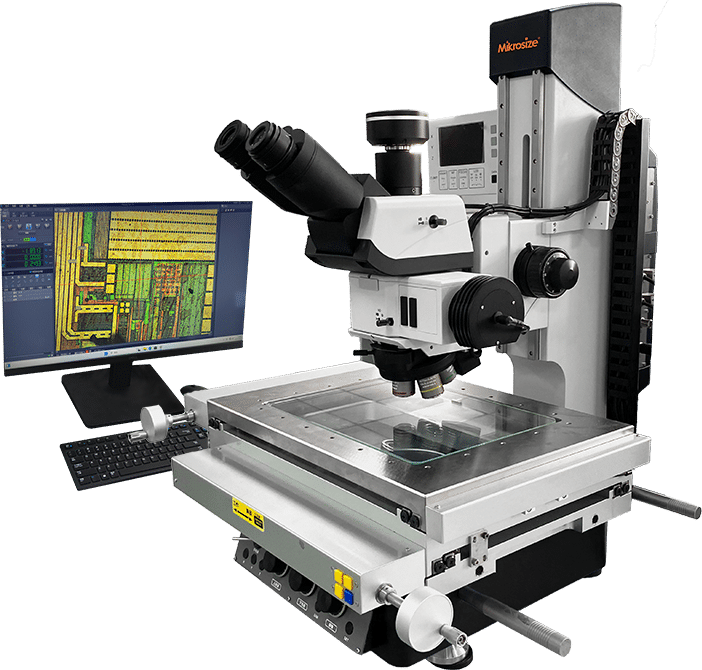
To satisfy demanding high-resolution battery material observation, metallographic assessment and precision component inspection, Mikrosize provides the uVision Toolmakers Microscope, built for industrial quality labs and battery R&D facilities.


Core Product Features
- The trinocular eyepiece tube adopts a 100:0 light-splitting ratio. Multiple observation modes can be switched flexibly to match diverse battery-sample observation requirements.
- Compatible with premium high-performance objective lenses including the Plan-S-APO series. These lenses deliver superior imaging fidelity and accurately restore subtle micro-details of electrode particles, separator surfaces and cross-section interfaces.
- Optional rear-mounted electric motor-driven objective converter, improving testing throughput for batch battery-sample observation.
- Manual coarse/fine focusing structure fitted with a green semi-circle focusing-assist marker. Operators achieve fast, sharp and precise focusing with simplified workflows.
- Equipped with a 6-megapixel CCD camera and USB3.0 high-speed interface, realizing efficient image capture and rapid data transmission for battery microscopic images, convenient for offline data sorting, report-generation and long-term sample archiving.
- Stable-brightness LED cold-light illumination lowers thermal radiation toward heat-sensitive battery samples, maintains crisp, bright viewing fields and extends the whole device service lifespan.
Targeted Applications for Battery-Related Workflows
- High-precision objectives plus ergonomic manual focusing support fine-structure inspection of battery assembly components, supporting high-accuracy precision assembly verification for battery-cell hardware parts.
- Multiple observation modes paired with stable cold LED light sources enable metallographic structure analysis of battery metal current collectors and material-property evaluation for conductive substrates.
- Large-travel high-accuracy workbenches facilitate observation of micro-cracks, surface scratches and localized material defects across varied battery workpiece samples.
- Capable of observing and analyzing chip-level micro-structures, surface flatness, circuit traces and multi-layer material interface conditions, which can be extended to inspect battery management system (BMS) circuit boards and peripheral electronic components for new-energy batteries.
Conclusion
Industrial microscopes are foundational inspection equipment for advancing lithium-ion battery R&D and stable mass-production. From early-stage raw-material microstructure study, in-process defect screening, to post-cycling failure investigation, these precision instruments elevate battery safety, boost finished-product consistency, and drive the sustainable advancement of the global new-energy vehicle industry. As a high-tech manufacturer concentrating on industrial metrology hardware, Mikrosize delivers the uVision Toolmakers Microscope to address real-world pain points of battery laboratories and manufacturing plants. With high-fidelity imaging performance, flexible multi-mode observation, and reliable data-acquisition capacity, this instrument offers robust technical backing for battery material innovation, production quality enhancement and failure-analysis workflows. Moving forward, as battery-industry technical requirements keep rising, industrial microscopy solutions will see even wider and deeper adoption within the full lithium-ion-battery value chain.